




Zeller van Almsick curated by Franz Thalmair
„Minda Andrén. Touch!“
www.zellervanalmsick.com
Curator(s):
Franz Thalmair is a curator, writer, and editor based in Vienna, Austria. He worked as a curator of contemporary art at the mumok – Museum moderner Kunst Stiftung Ludwig Wien (2019–2026) and as artistic director and curator at Kunstraum Lakeside in Klagenfurt (2018–2026). Previously he served as general manager and curator at the Secession in Vienna (2010–2014) and was also a visiting professor, lecturer, and researcher at the University of Applied Arts Vienna (2013–2025). His writing appears regularly in media such as Artforum, KUNSTFORUM International, and springerin – Hefte für Gegenwartskunst, as well as in numerous exhibition catalogues and artists’ books.
Artist(s):
-
Minda Andrén (born 1990 in Sweden) Minda Andrén lives and works in Vienna, where she studied at the Academy of Fine Arts under Daniel Richter. Andrén builds visual riddles from the embedment of found and borrowed images that she collects from glimpses and motifs taken from our daily surroundings, physical and digital media. Andrén resignifies the original images into playful, intricate compositions that dislocate their original connotation to ask questions about what happens when flows of images, meaning, and interpretations overlap, thus playing with the temporalities of digital media from the supposed staticity of painting.
Minda Andrén’s hand-drawn and painted bodies emanate from our collective visual memory: from a 1970s massage book the artist found at a flea market in Brazil, with pictures not only of a body being massaged but, in a hippie-inspired spirit of freedom, also a naked body performing the massage; from internet forums on (not always) evidence-based “somatic therapy,” which promises relief from chronic stress and post-traumatic disorders and to regulate the nervous system, a restored harmony of body and mind to master the challenges of life; from instructions for gymnastic exercises that transform ritualized movement sequences and breathing techniques from non-European contexts, stippled with lore about their millennia-old traditions, into a spiritual experience, a Western experience; from (pseudo-)medical diagrams with titles like Bodymind that use conceptual pairs such as “disability and decay” and “growth and empowerment” to wedge the human body into ever more definitions and thereby perpetuate categorical polarizations; from pop culture memorabilia like the scene in Juzo Itami’s film Tampopo (1985), which stages the mouth-to-mouth exchange of a raw egg yolk as a choreography of intimacy, desire, and transcendence between two bodies—and from a visual amalgam of everything in between.
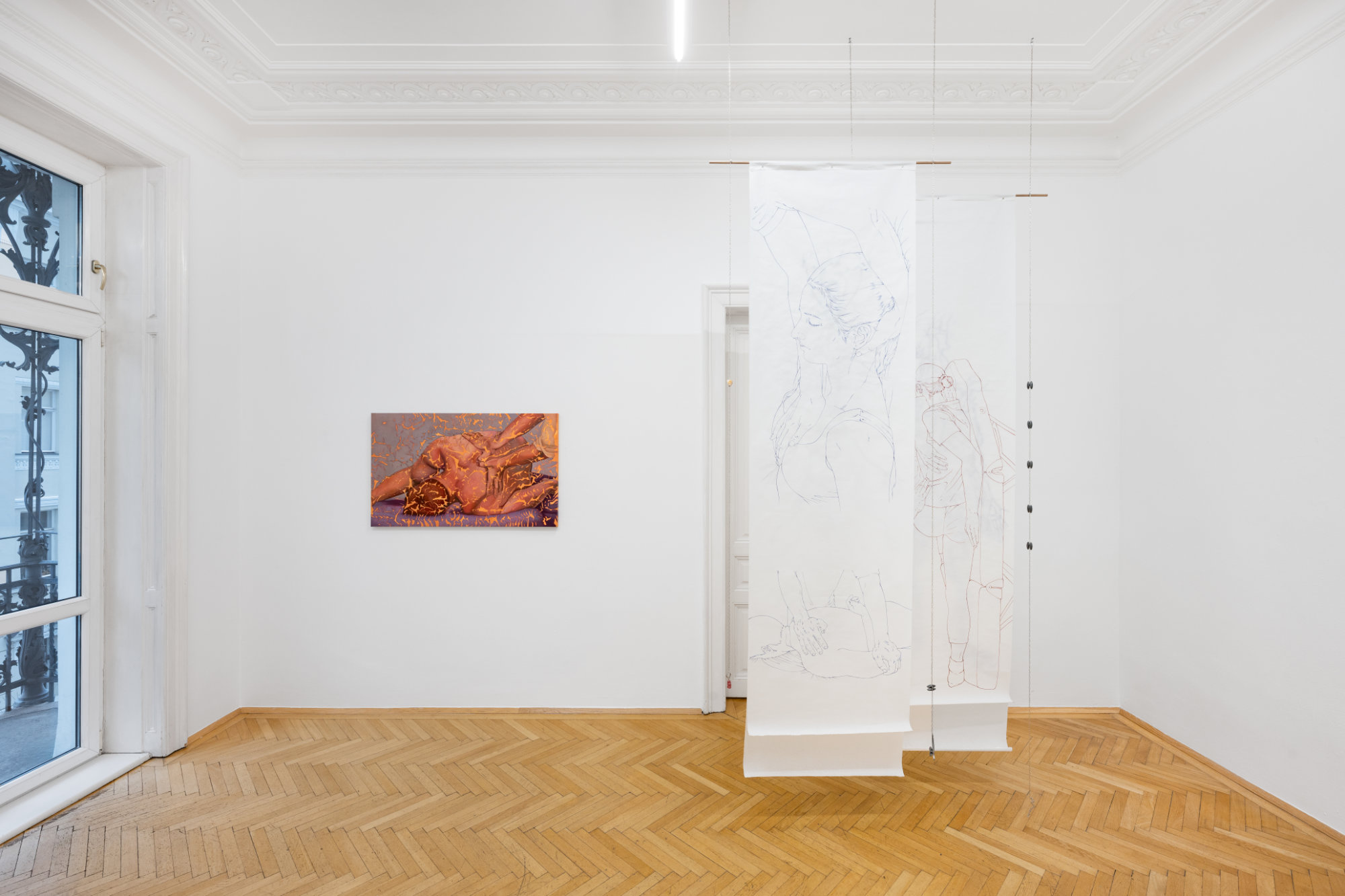
A recurring motif in Minda Andrén’s drawings, paintings, and installations is touch: derived from these multifarious visual sources, touch manifests as healing, spiritual practice, erotic acts, or as a gesture of care. The artist frees these interpretations from their context and condenses them into moments of pure physical negotiation in which bodies, or more precisely the encounter between at least two bodies, becomes a site of relationships, dependencies, and self-determination, for social norms and control. Wellness (2026) is the title of one of Andrén’s most recent paintings on this subject:
Fig. 1
The man’s left arm is raised, resting at a right angle on his lower back. Held in place. One hand weighs down his shoulder flat against his back, applying pressure with controlled intensity. A second hand grips around his elbow, fingers wrapped tightly around the joint, as if at any moment to stretch his upper arm further, pushing it to its limits. The muscles of both bodies are tense, two connected forces seeking each other out. The degree of freedom, like a game, is mutually agreed upon. Consensus. The face of the man lying on his stomach is turned to the side, sunken deeply into the sheet, a patient carrier of his bare torso. No smile, no glance back. Touch by mutual consent.
Mina Andrén picks up on what Michel Foucault describes as “technologies of the self,” and not just as her visual subjects; those social strategies that “permit individuals to effect by their own means or with the help of others a certain number of operations on their own bodies and souls, thoughts, conduct, and way of being, so as to transform themselves in order to attain a certain state of happiness, purity, wisdom, perfection, or immortality.” Beyond her choice of motifs, painting itself becomes a technology of the self in Andrén’s work, a technology of self-reflection. For the artist does not merely transfer her visual content from a found medium onto paper or canvas and into the space, rather she alters, superimposes, and transforms the material itself. These painterly, graphic, and installative interventions are in themselves forms of touch, and the artist reflects on the unique qualities of each. She physically engages with the material in an artistic handling, while critically examining the images of the body, norms, and ideas inscribed within.
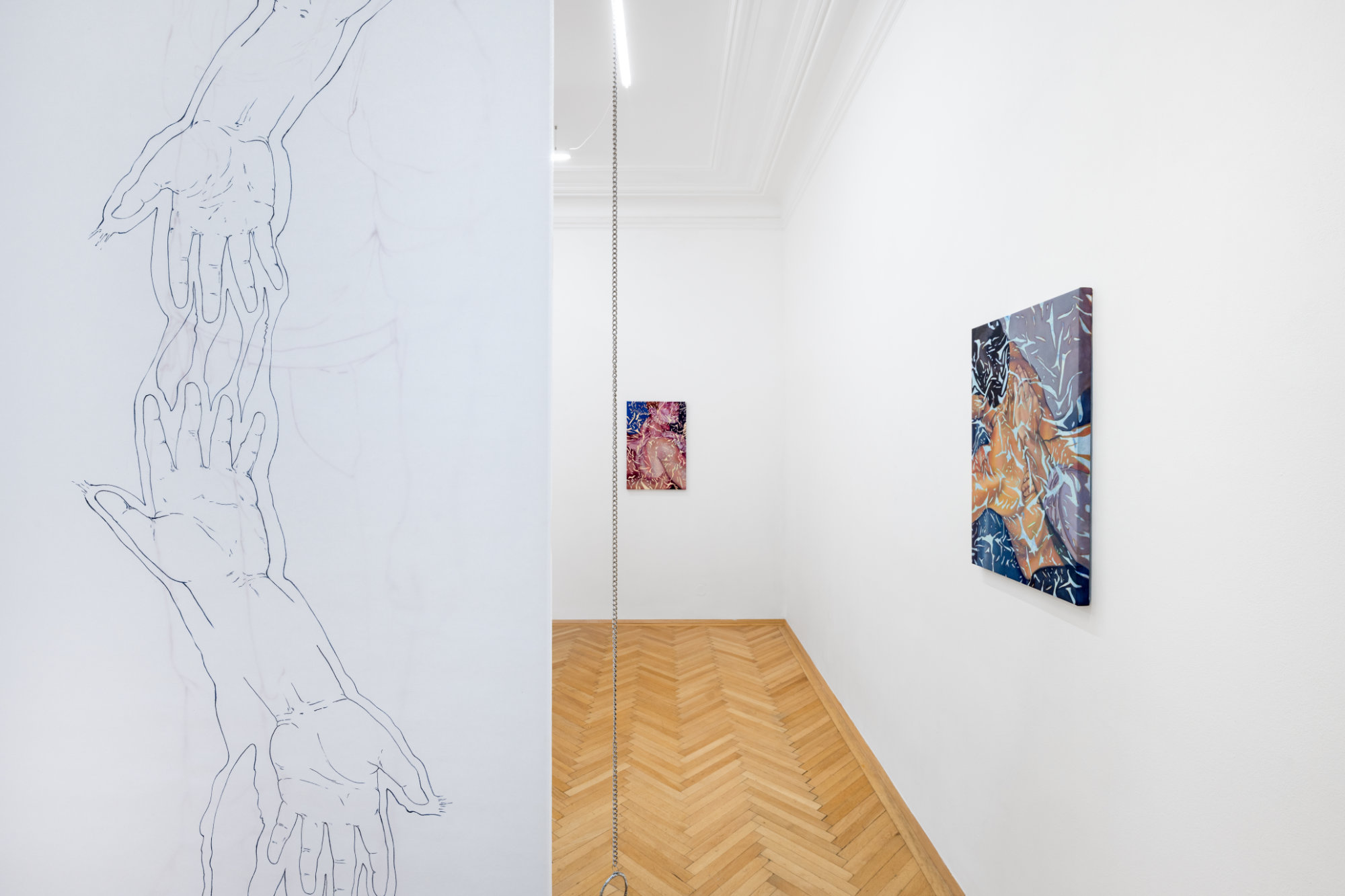
For Wellness and the other works in this series, Minda Andrén first makes a sketch on paper and places it on the canvas. She then moistens both paper and canvas with water and ink, creating immediate contact between the two surfaces that merges them into a single image plane. Once dry, Andrén separates the materials again and begins working on the canvas with oil paint, following the traces left superficially by the paper, ink, and the shadow of the drawing. All going well, the paper remains intact during this process; Wellness(ssenlleW) becomes a kind of “sister work” alongside the painting, in the artist’s words.
Springing from the same origin, our collective visual memory of the corporeal, both works have become an inseparable whole in this moment of reciprocal touch, without one being a discernible “original” and the other the “copy.” Instead, the imprints between the paper and the canvas remain as marks on both surfaces. Each image conveys the process of their respective becoming. On the canvas, the traces left behind from their contact and Andrén’s subsequent painterly treatment take on a craquelure effect, a result from the capillary spread of the ink on the paper. In her approach to the surface, the artist does not have a distinct composition in mind. In its branching nature, plus the intrinsic element of chance, which always plays a constitutive role in the creative process, Andrén’s artistic method bears parallels to Donna Haraway’s “tentacular thinking,” a way of thinking that conceives of relationships not as fixed points or clear boundaries but as an entanglement of connections: “Tentacularity,” says the biologist and philosopher, “is about life lived along lines—and such a wealth of lines—not at points, not in spheres.” Lines that the artist literally picks up on as independent entities.
The traces of ink feel their way across the canvas like antennae, networking the image elements, causing motifs to appear less as contoured forms but as a porous structure. The fine lines of the paper drawing, too, dissolve into similar patterns and shapes. Observing these “sisters” side by side, comparative viewing inevitably sets in. The eye searches for similarities and differences between paper and canvas, tracing those residues and frays that have become material inscriptions in the pictorial planes and bear witness to different variants of touch. In Minda Andrén’s work, their effect unfolds on two levels at once: as the subject of the representation and as the material procedure of their creation. The images do not portray touch; they are its product.
Fig. 2
The man’s left arm is pulled upwards and pressed at a right angle against his lower back. Immobilized. One hand presses his shoulder flat against his back, its weight bearing down with unyielding pressure. A second hand grips his elbow, fingers clenched tightly around the joint, as if at any moment to pry his upper arm loose from its anchor. The muscles of both bodies are tense, suspended between two opposing forces. Their range of motion is strictly regulated. The face of the man lying on his stomach is turned to the side, it sinks into the surface upon which his bare torso is held down. No expression, no gaze. Touch under duress.
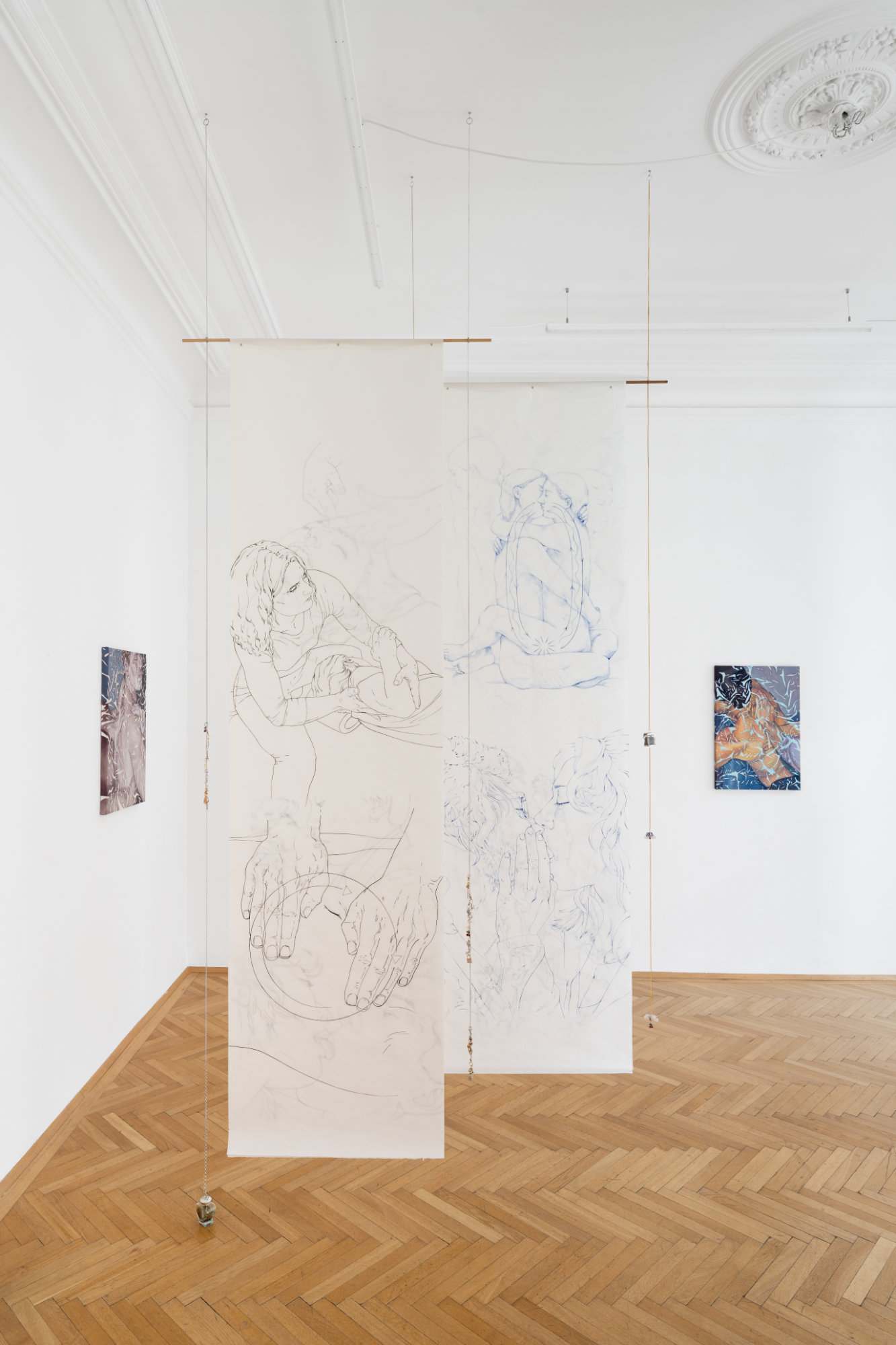
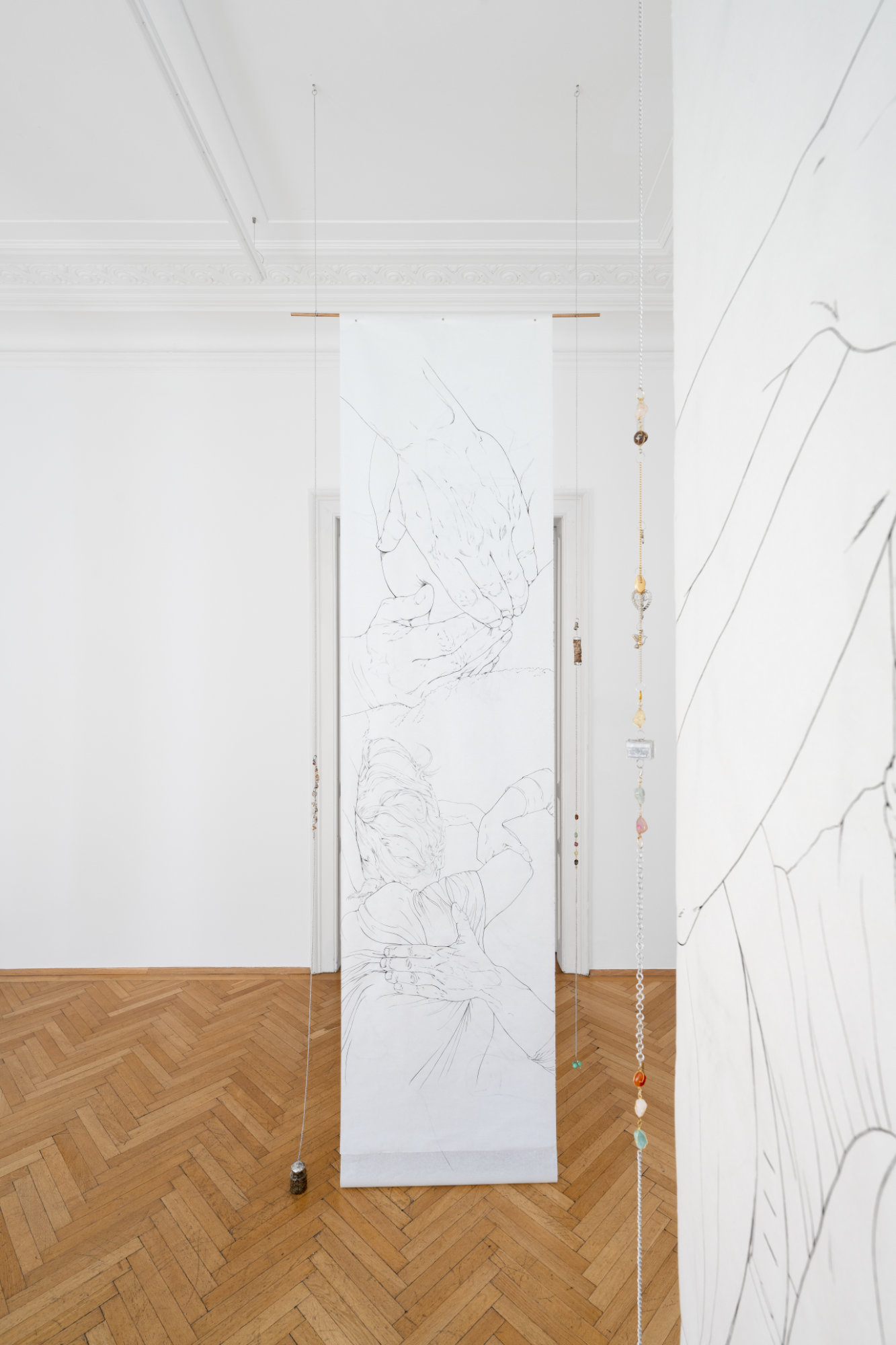
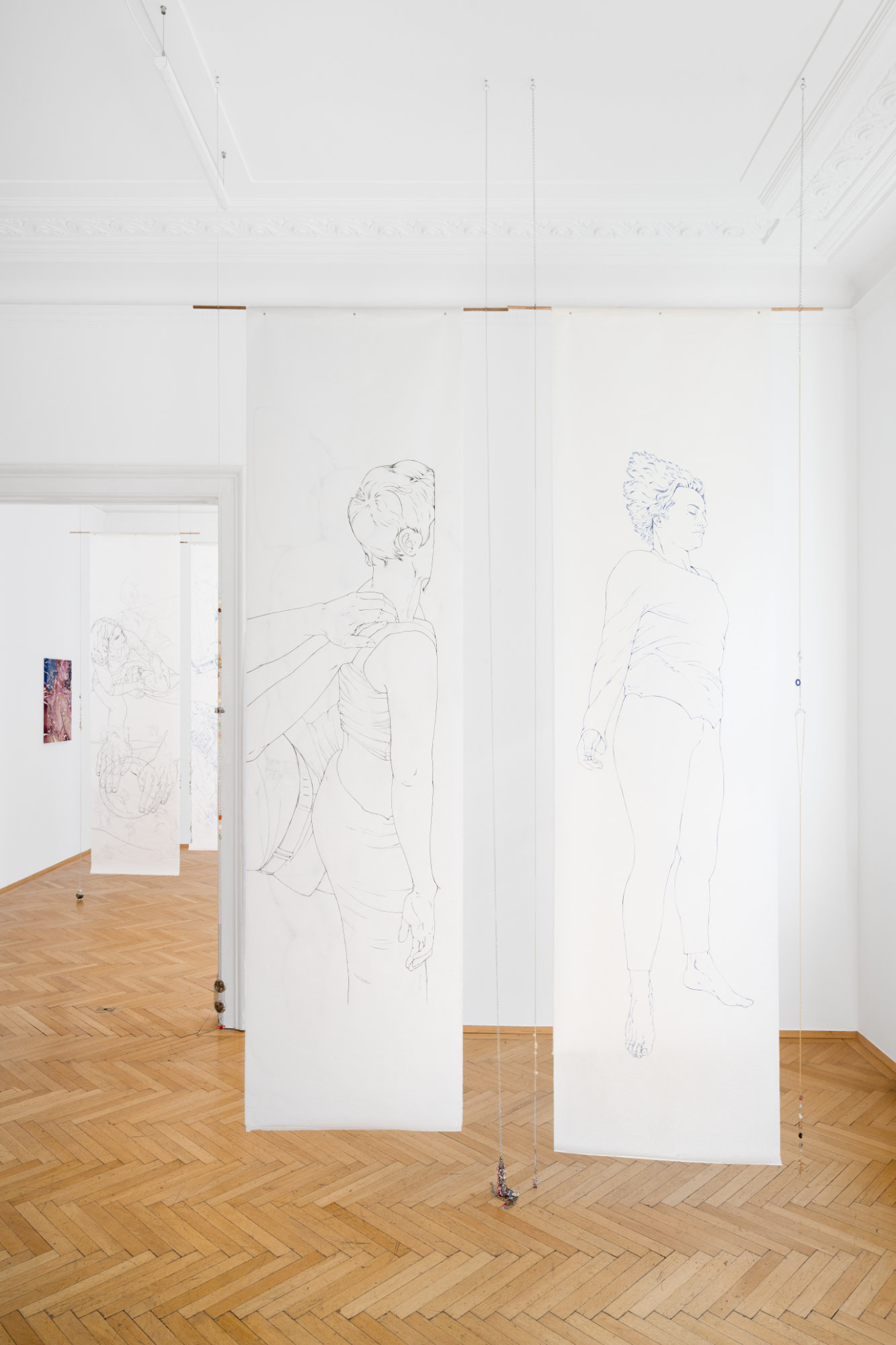
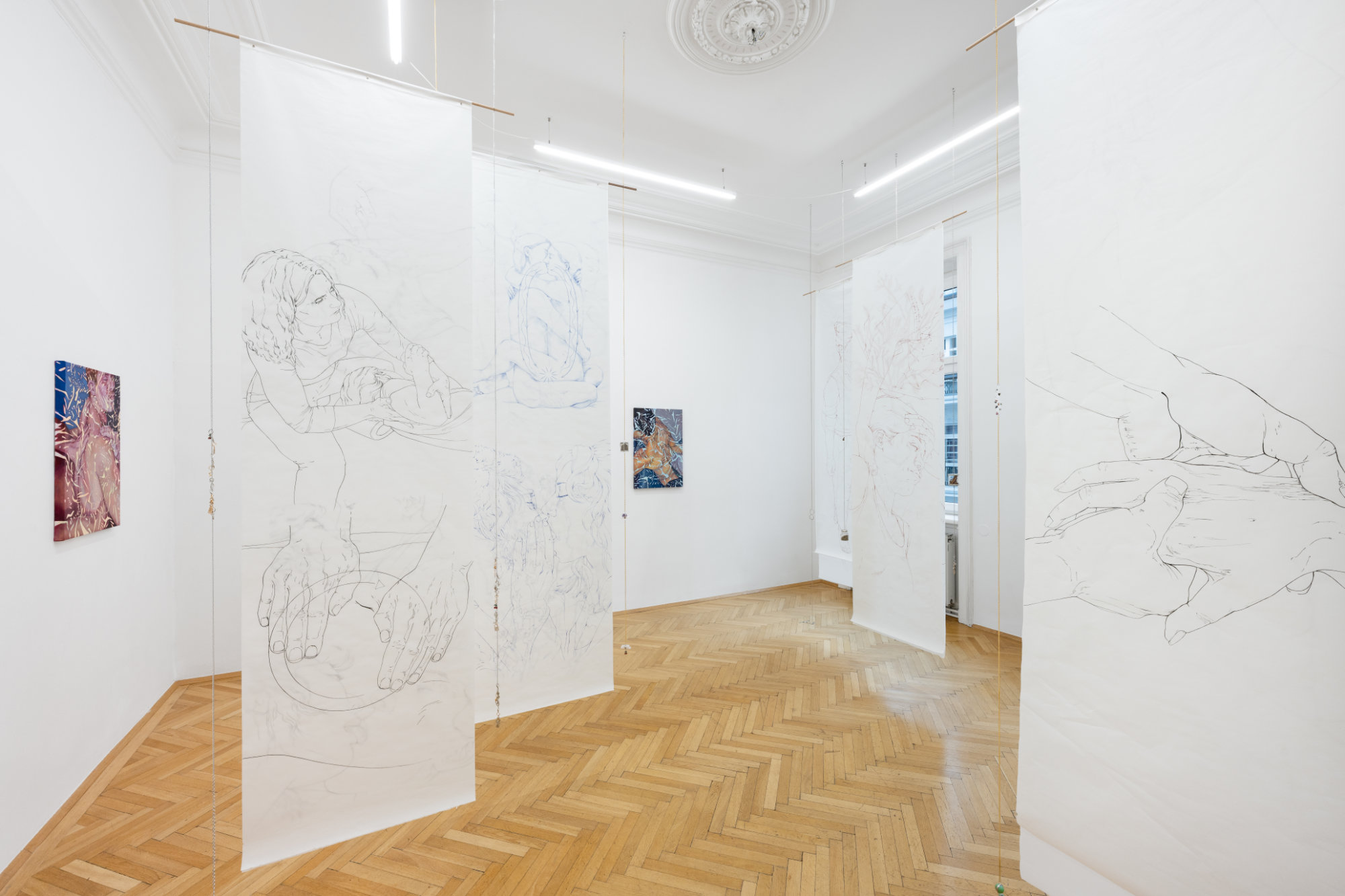
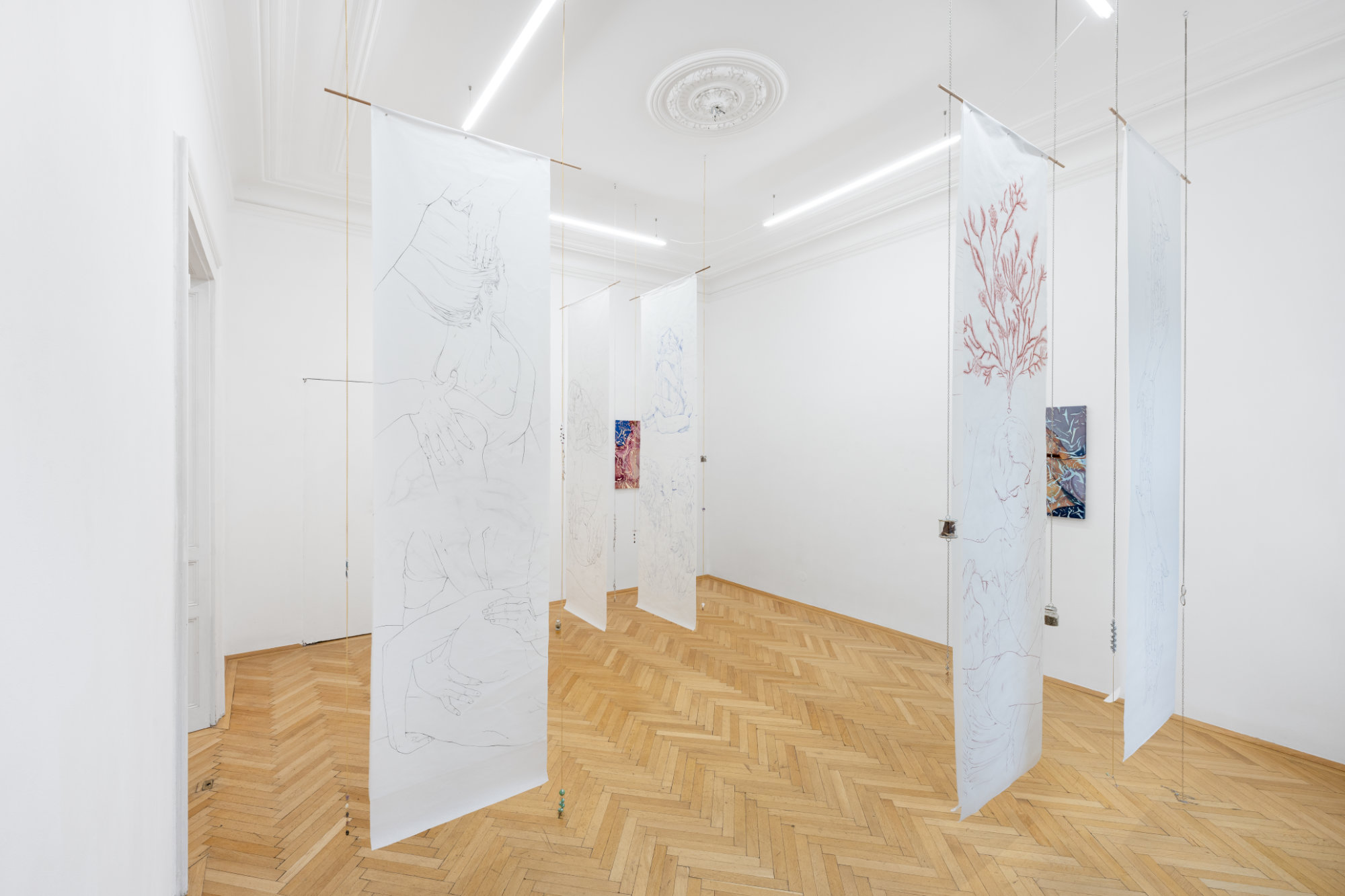
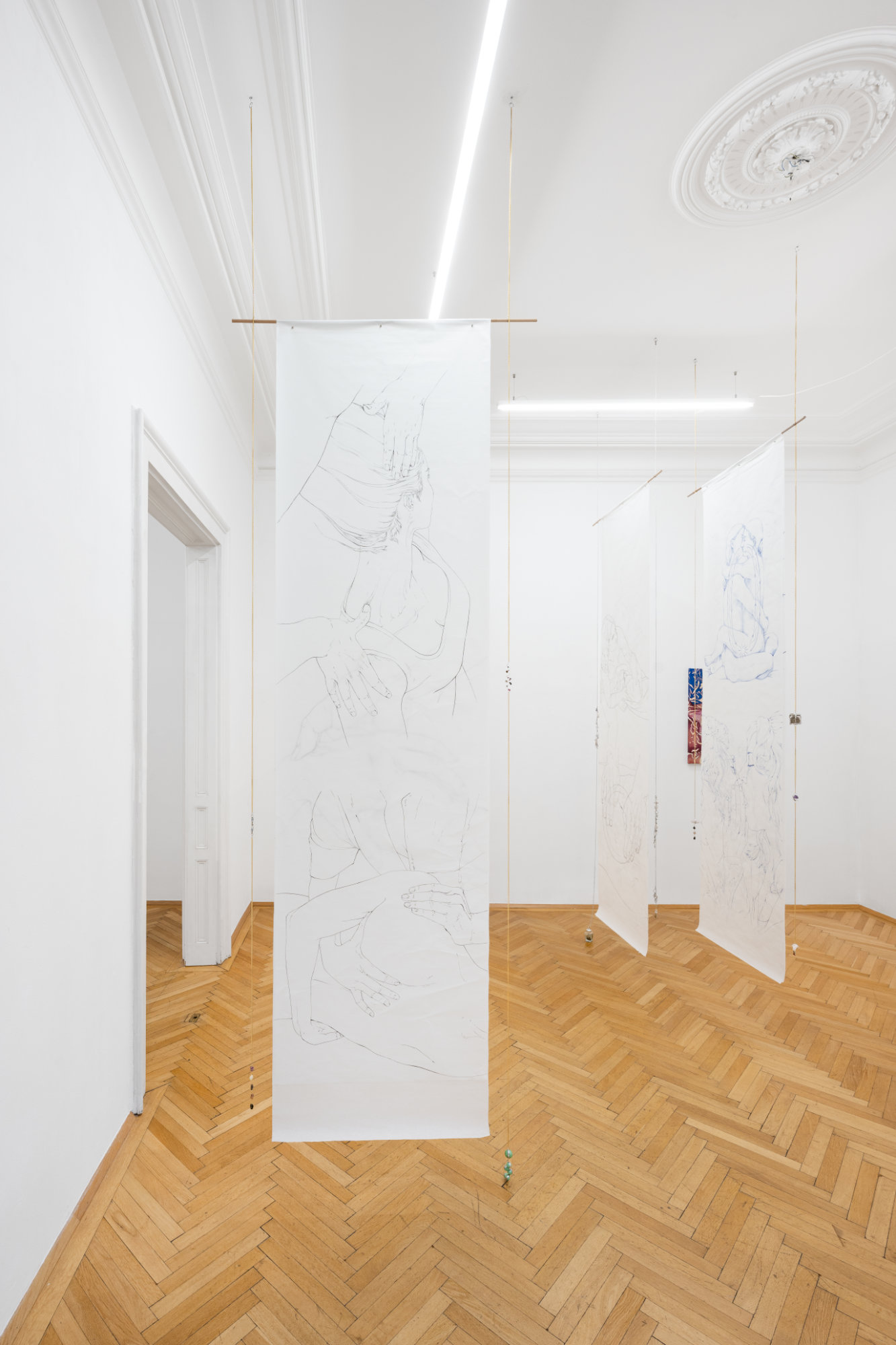
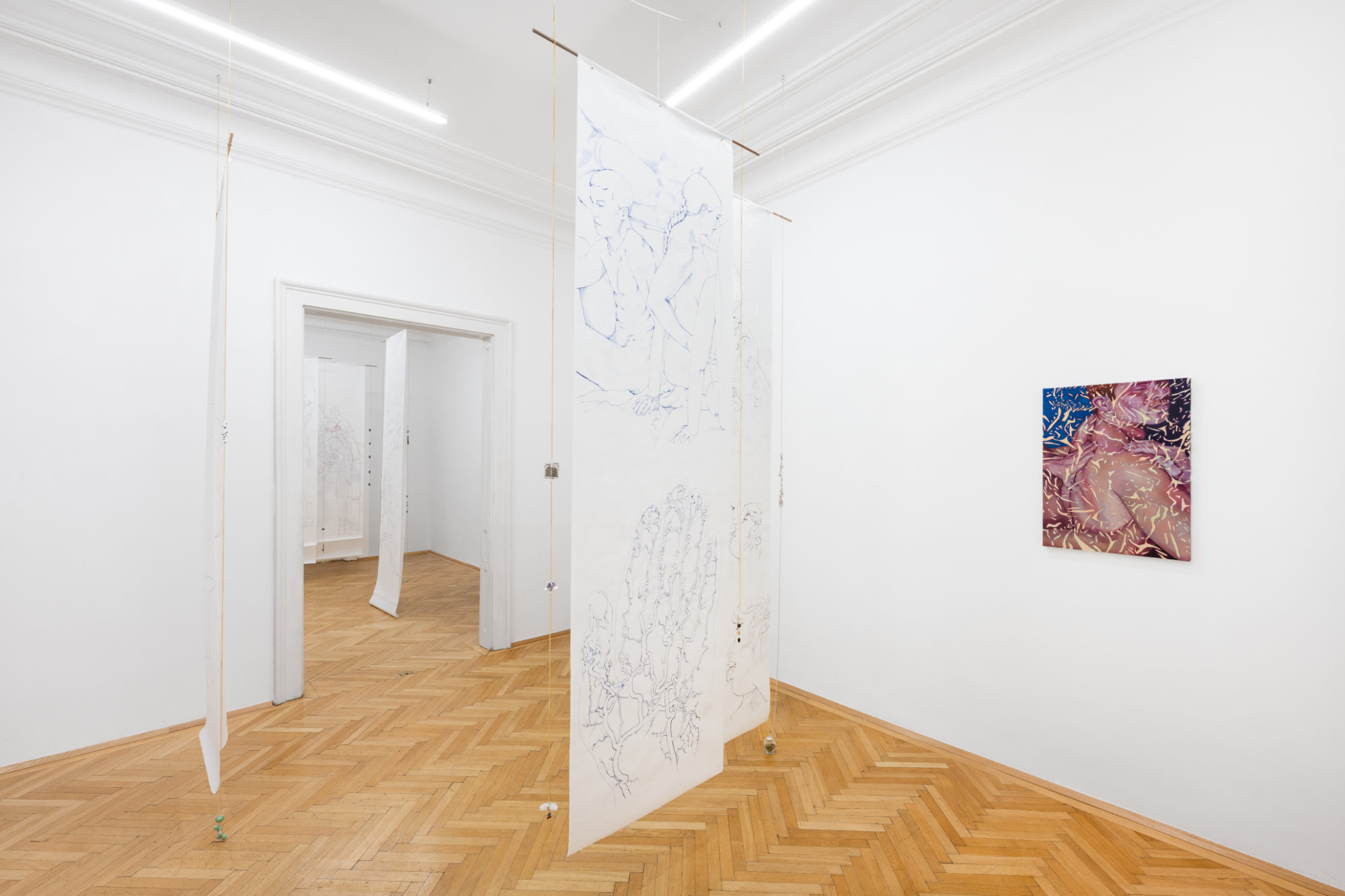
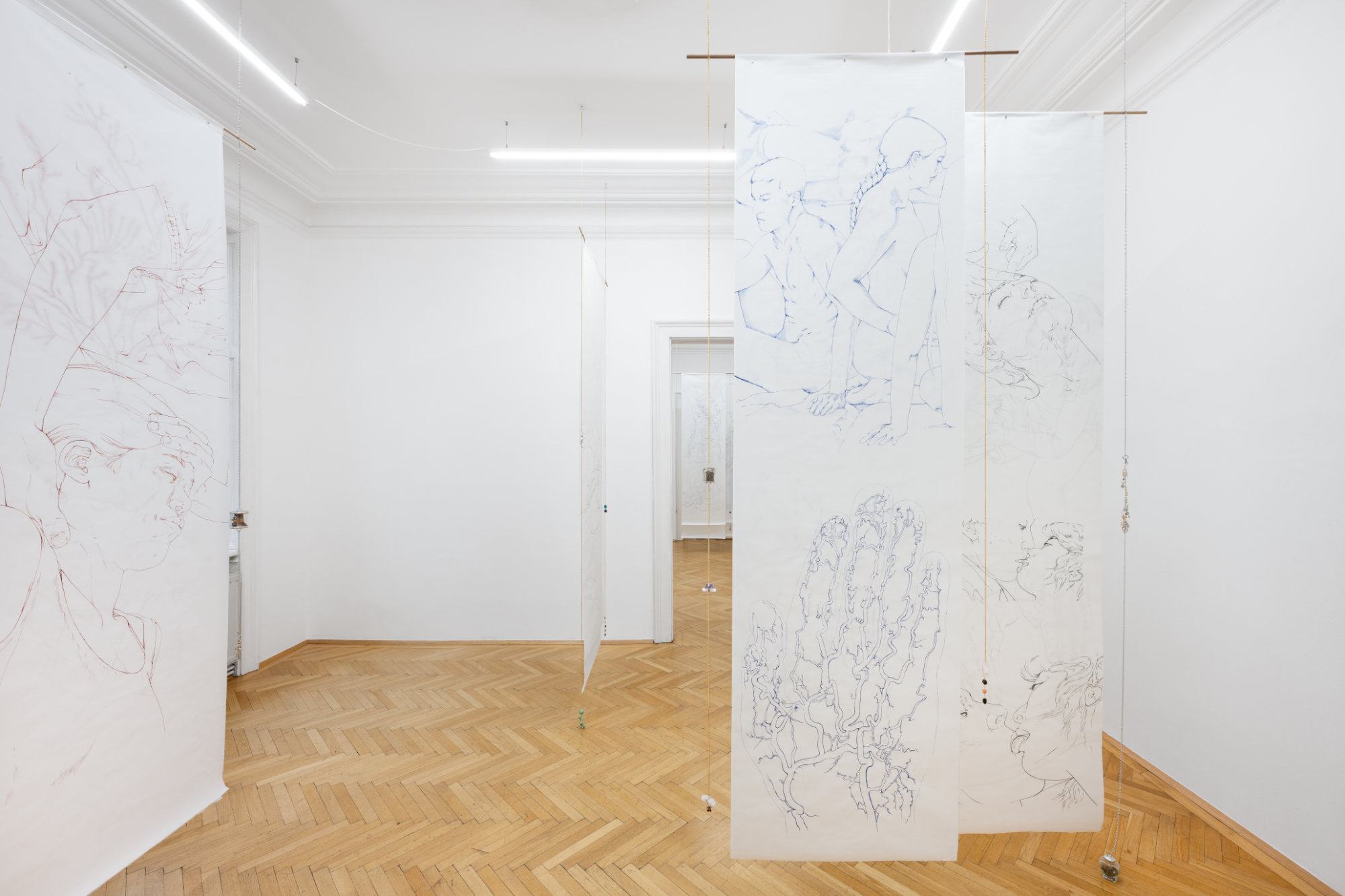
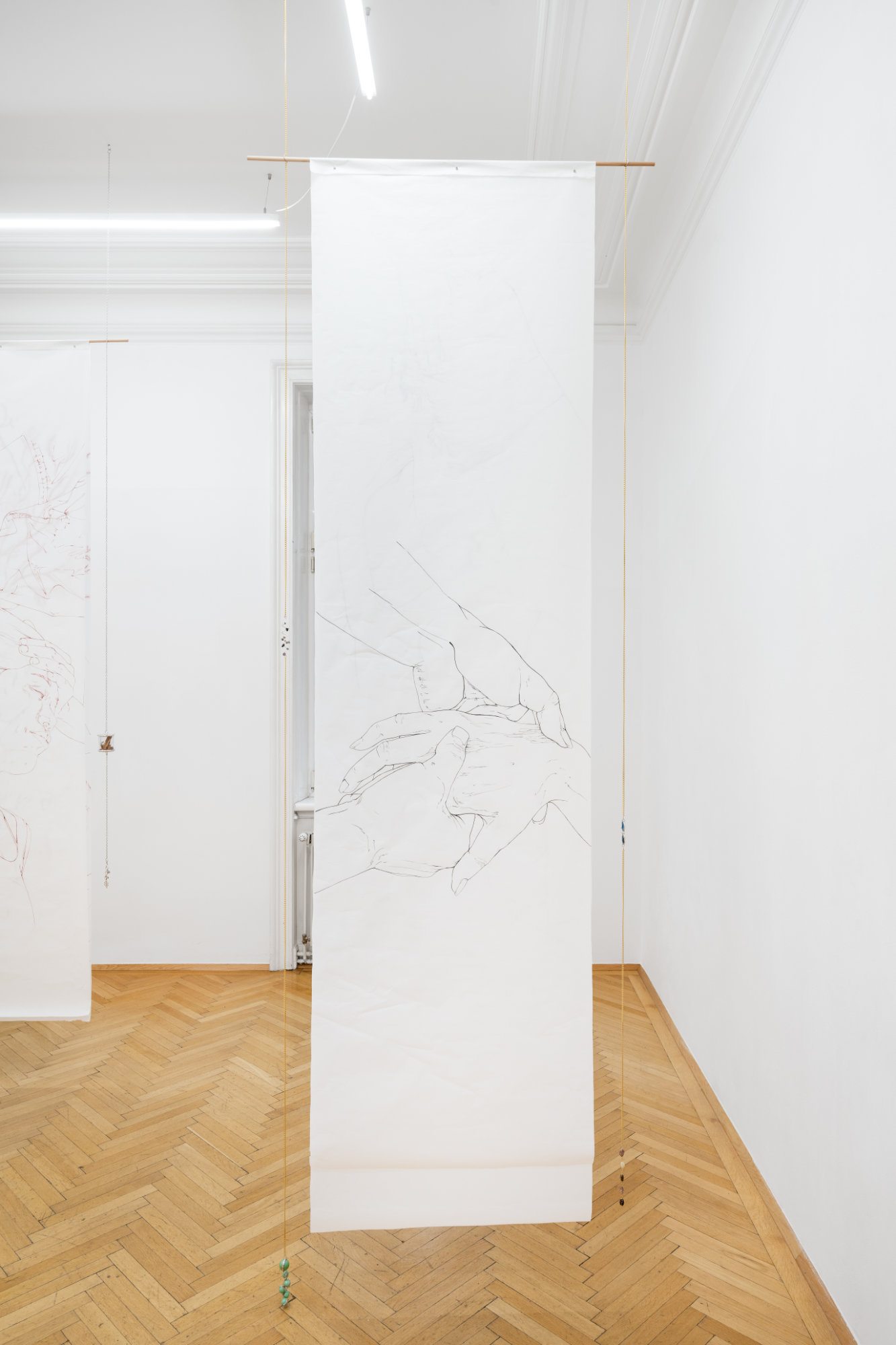
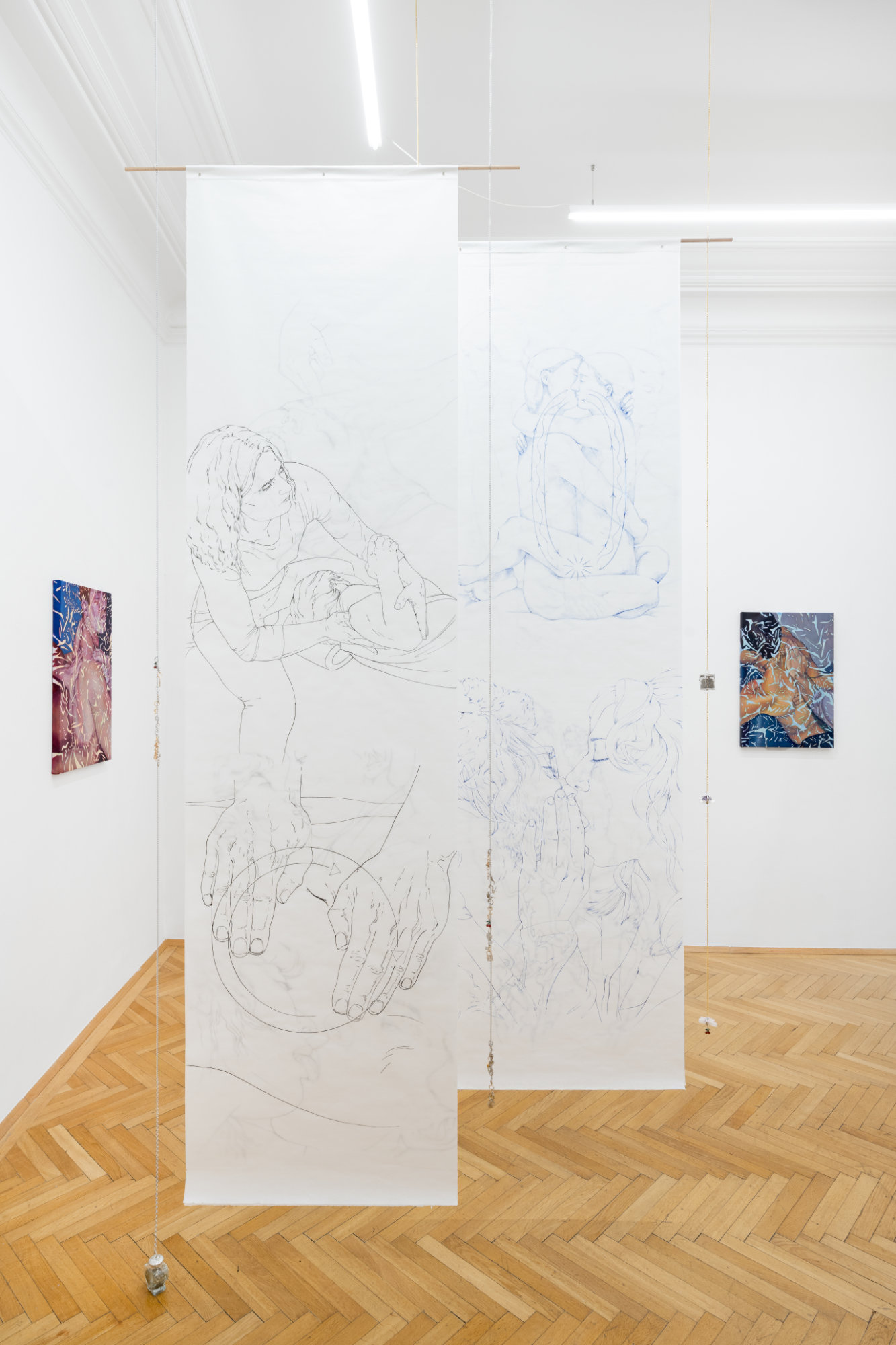
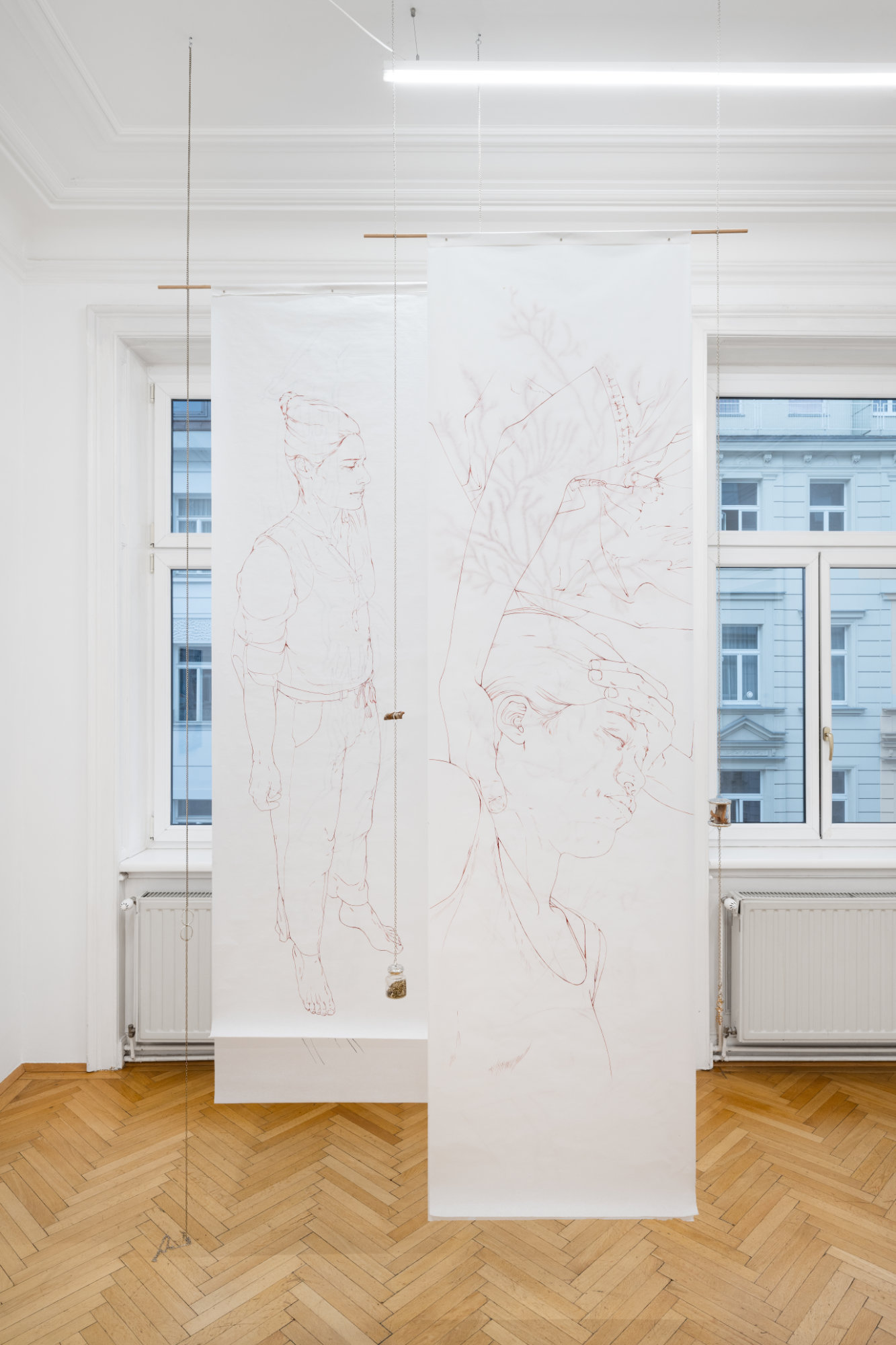
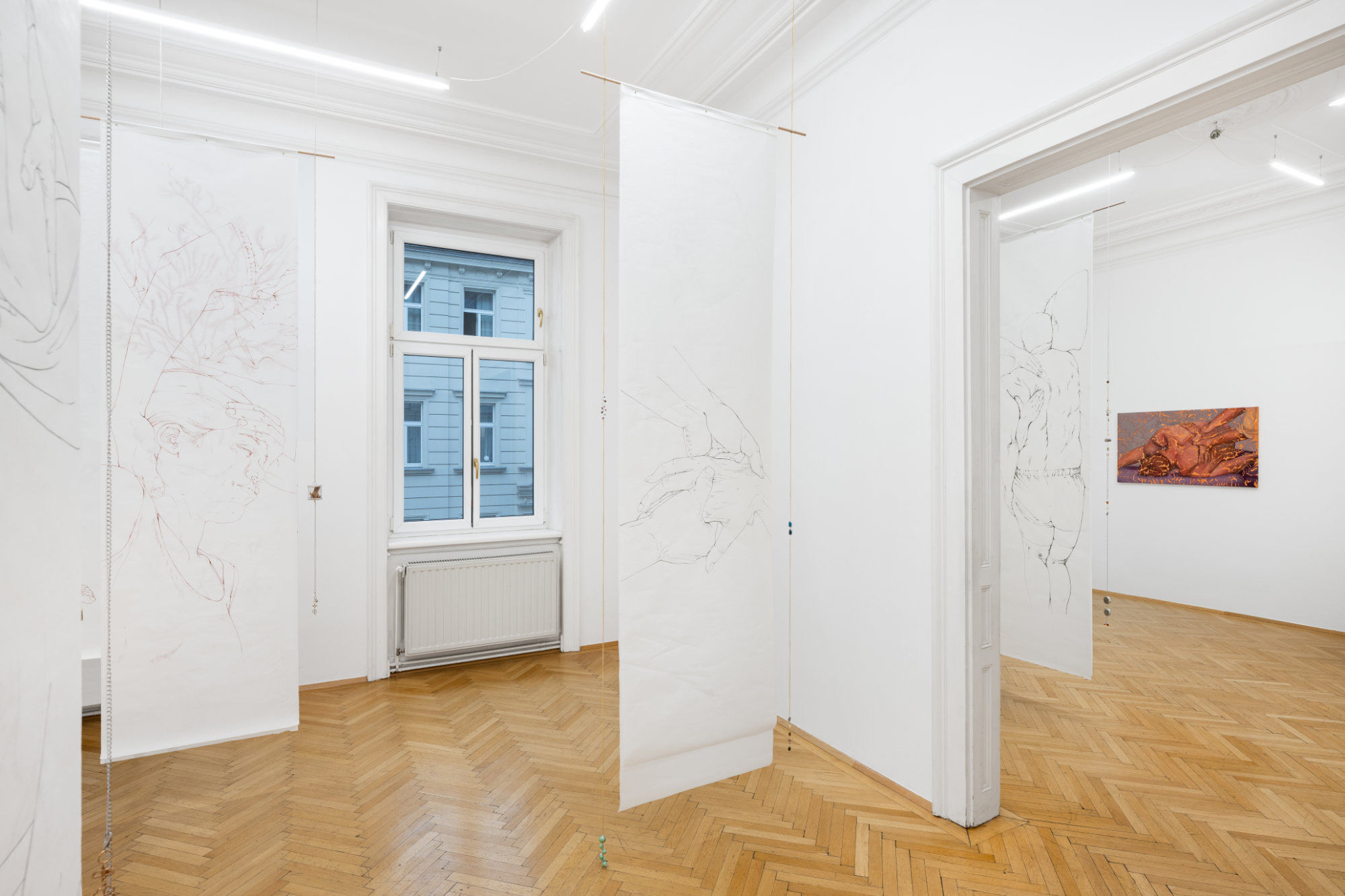
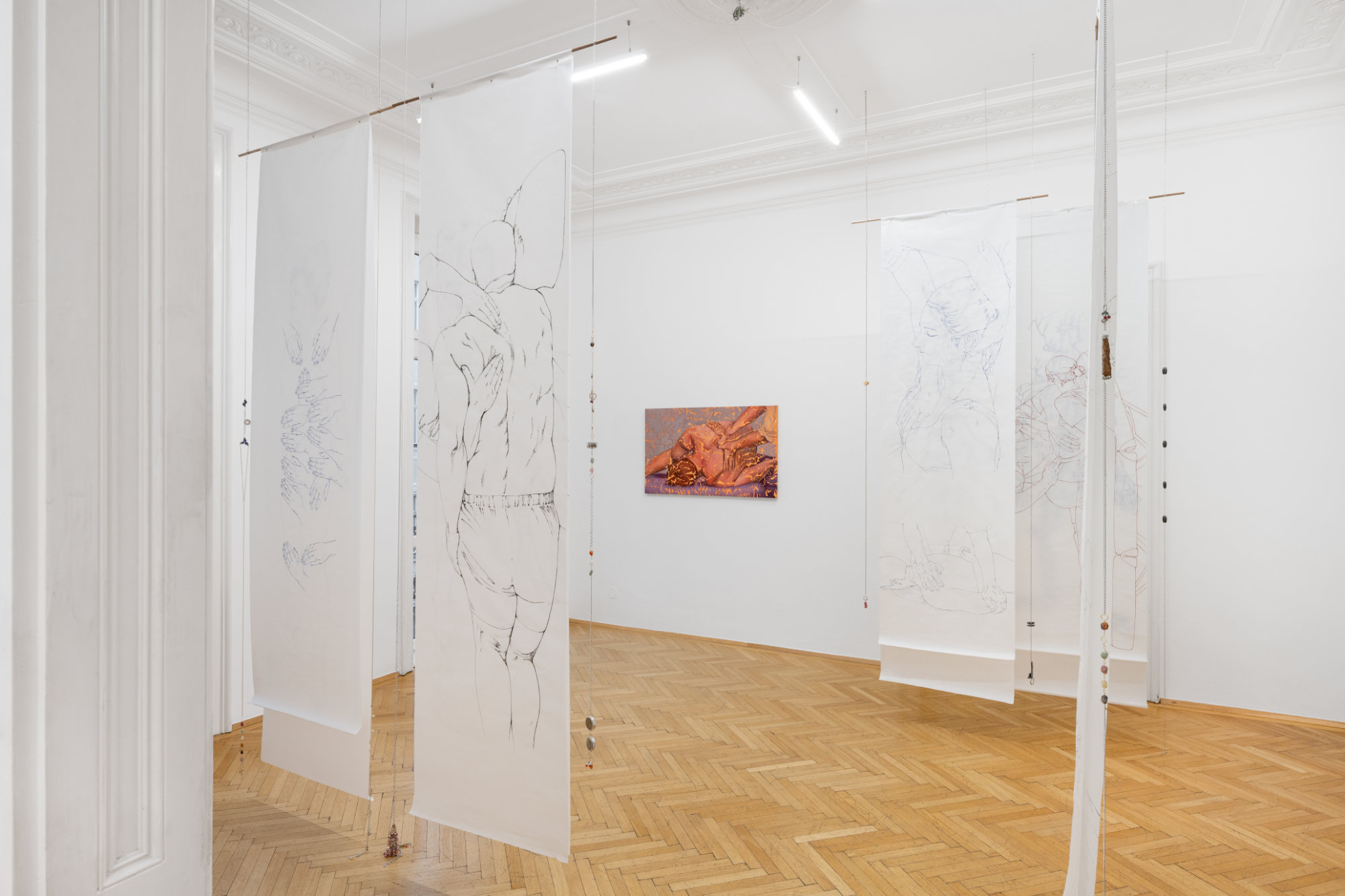
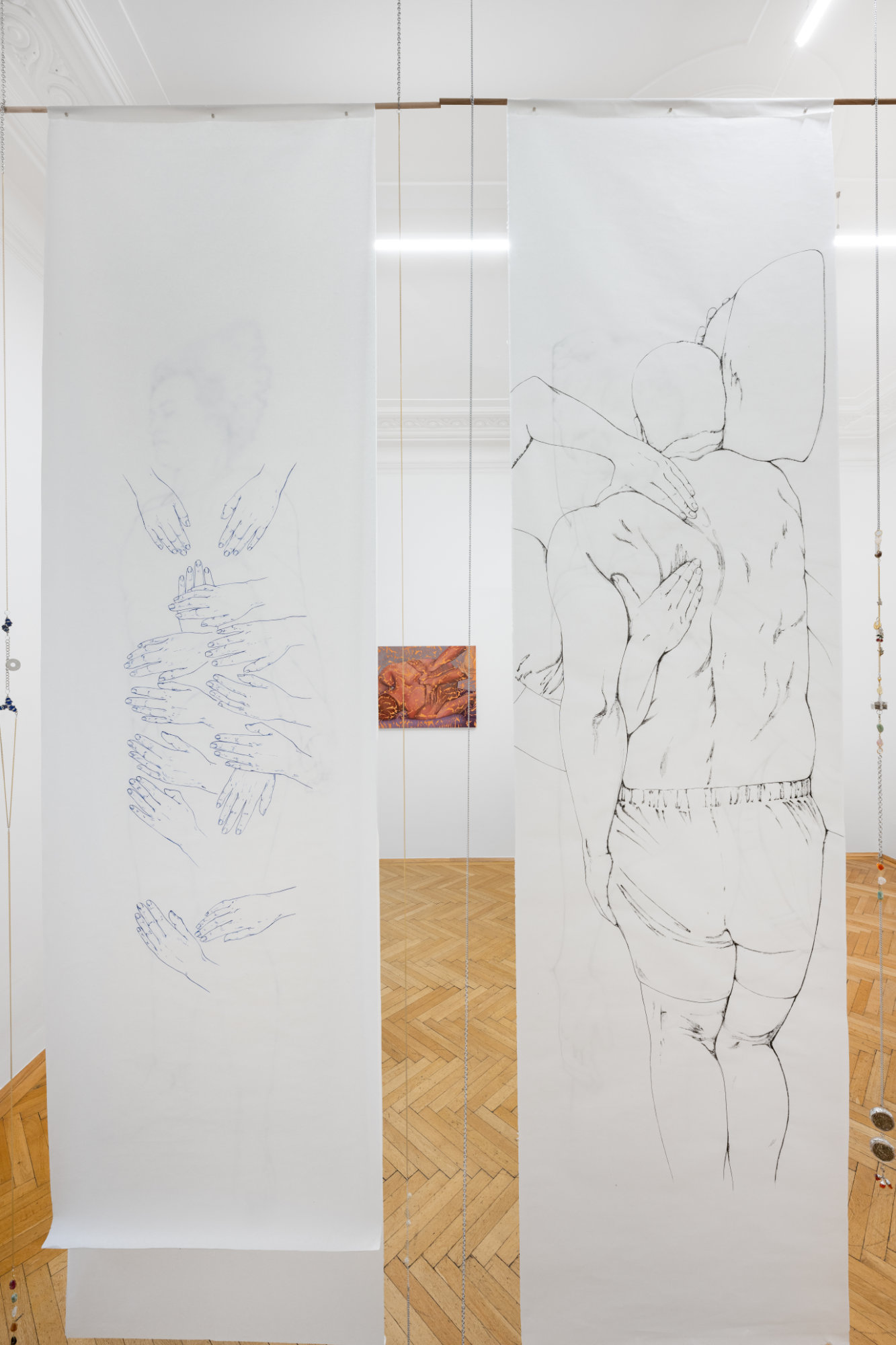
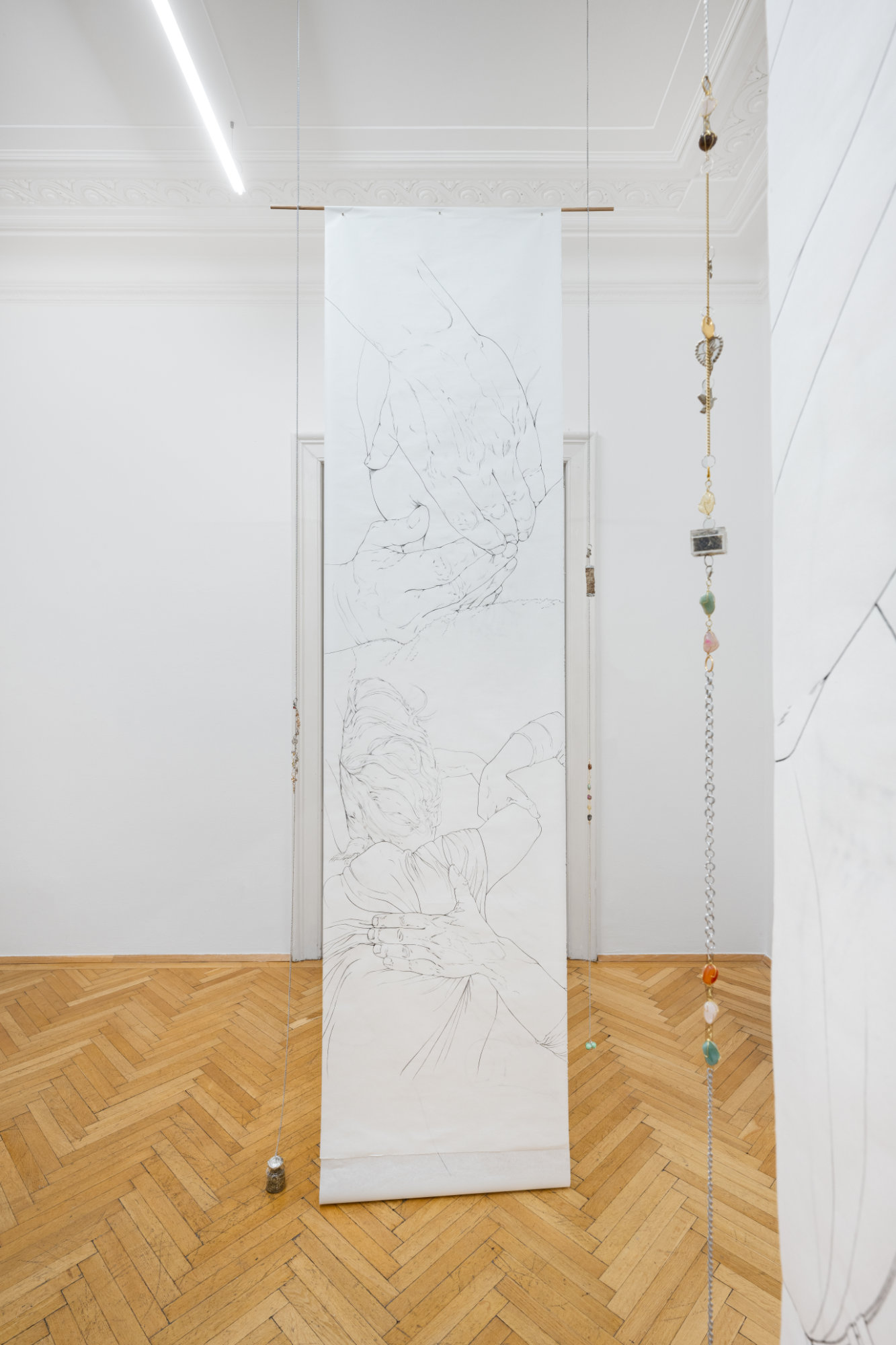
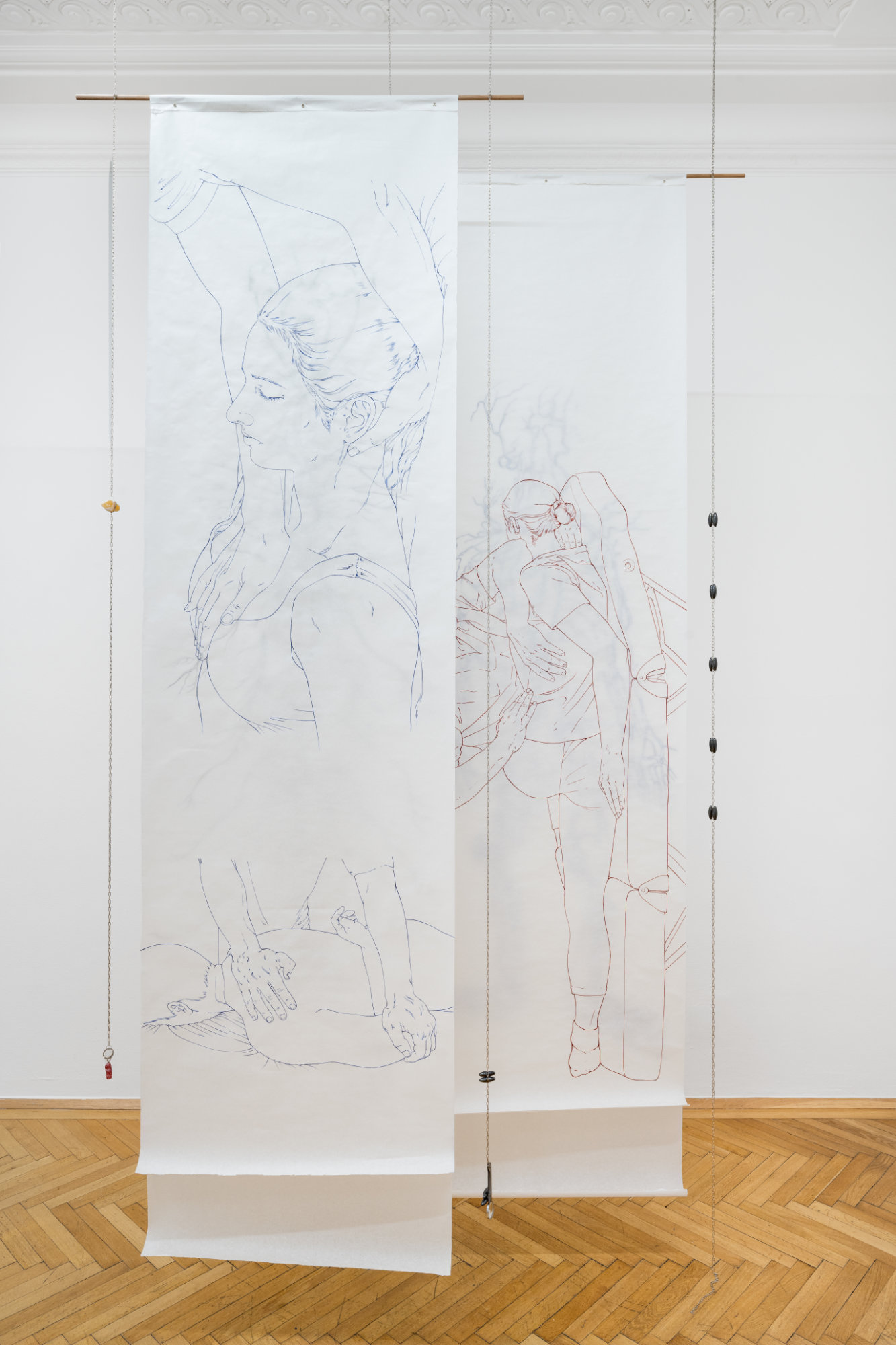
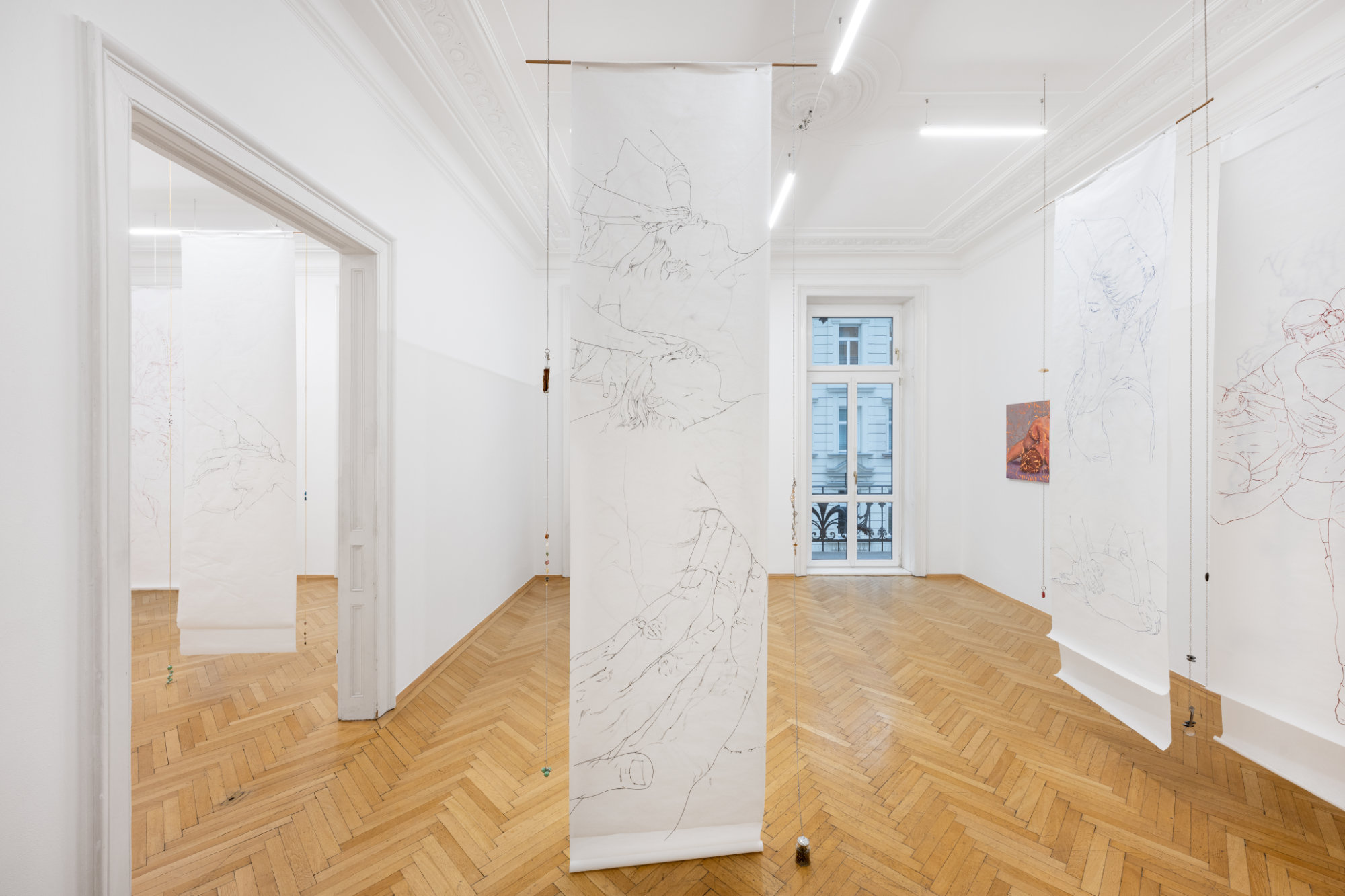
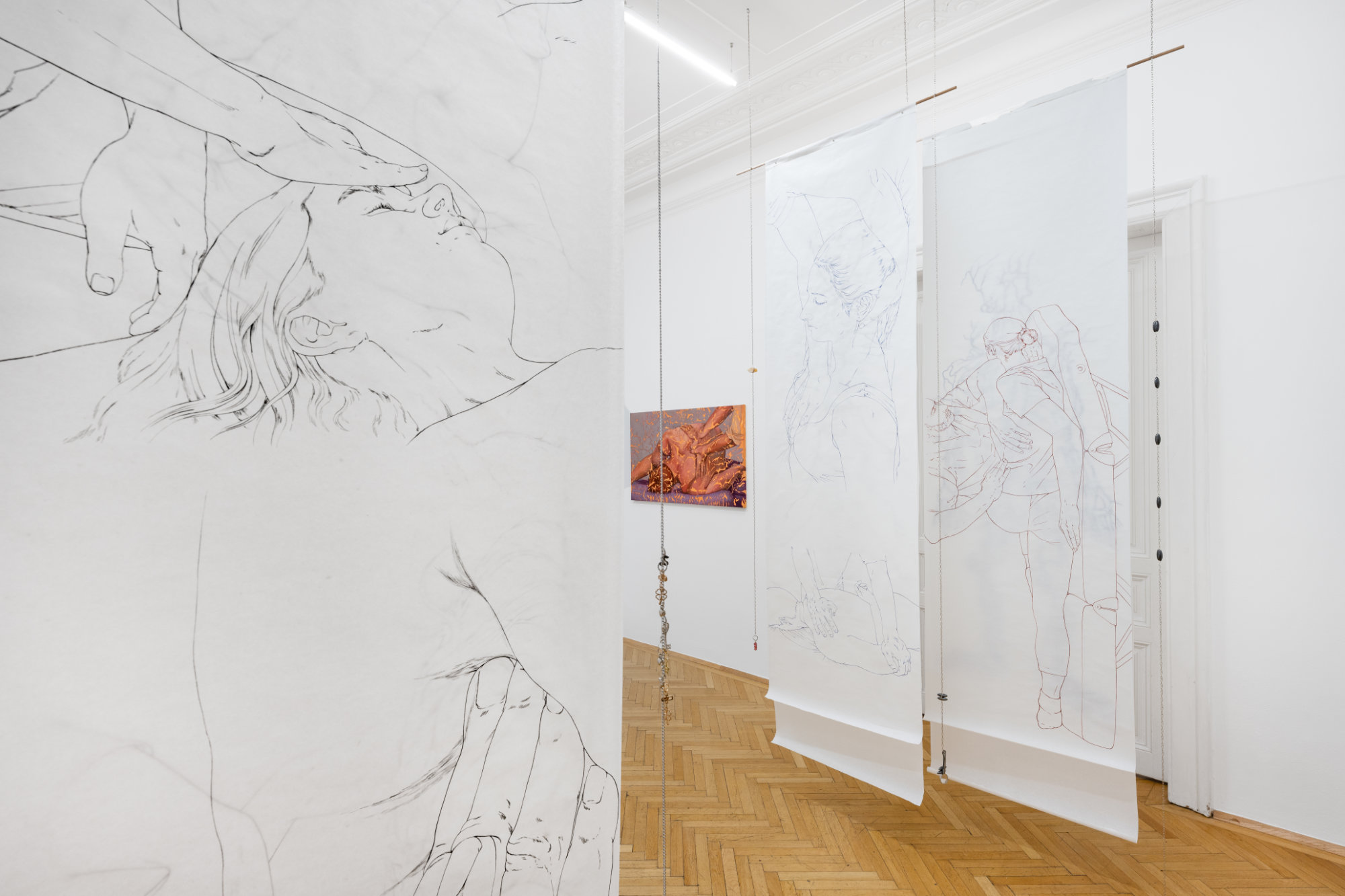
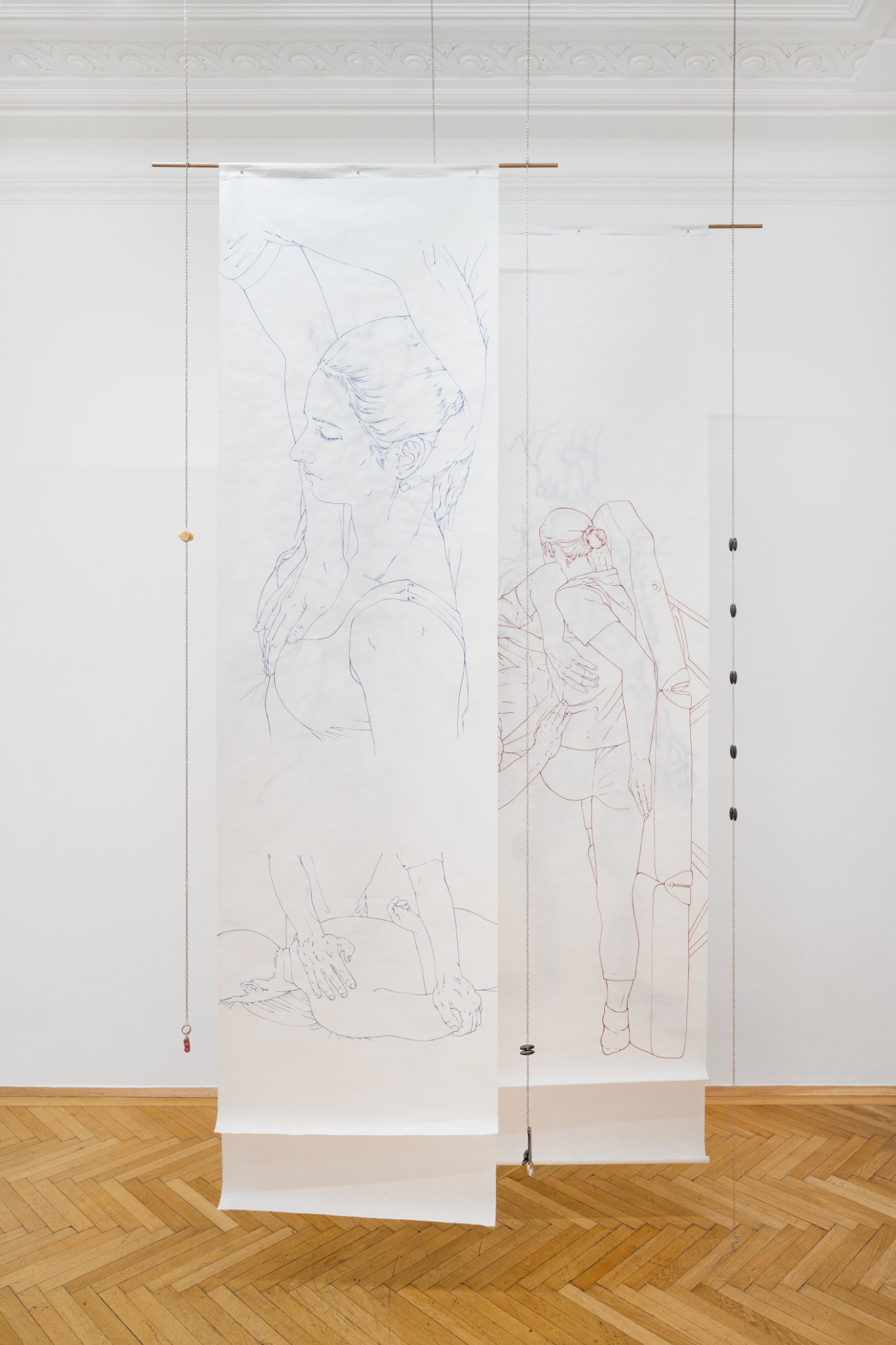
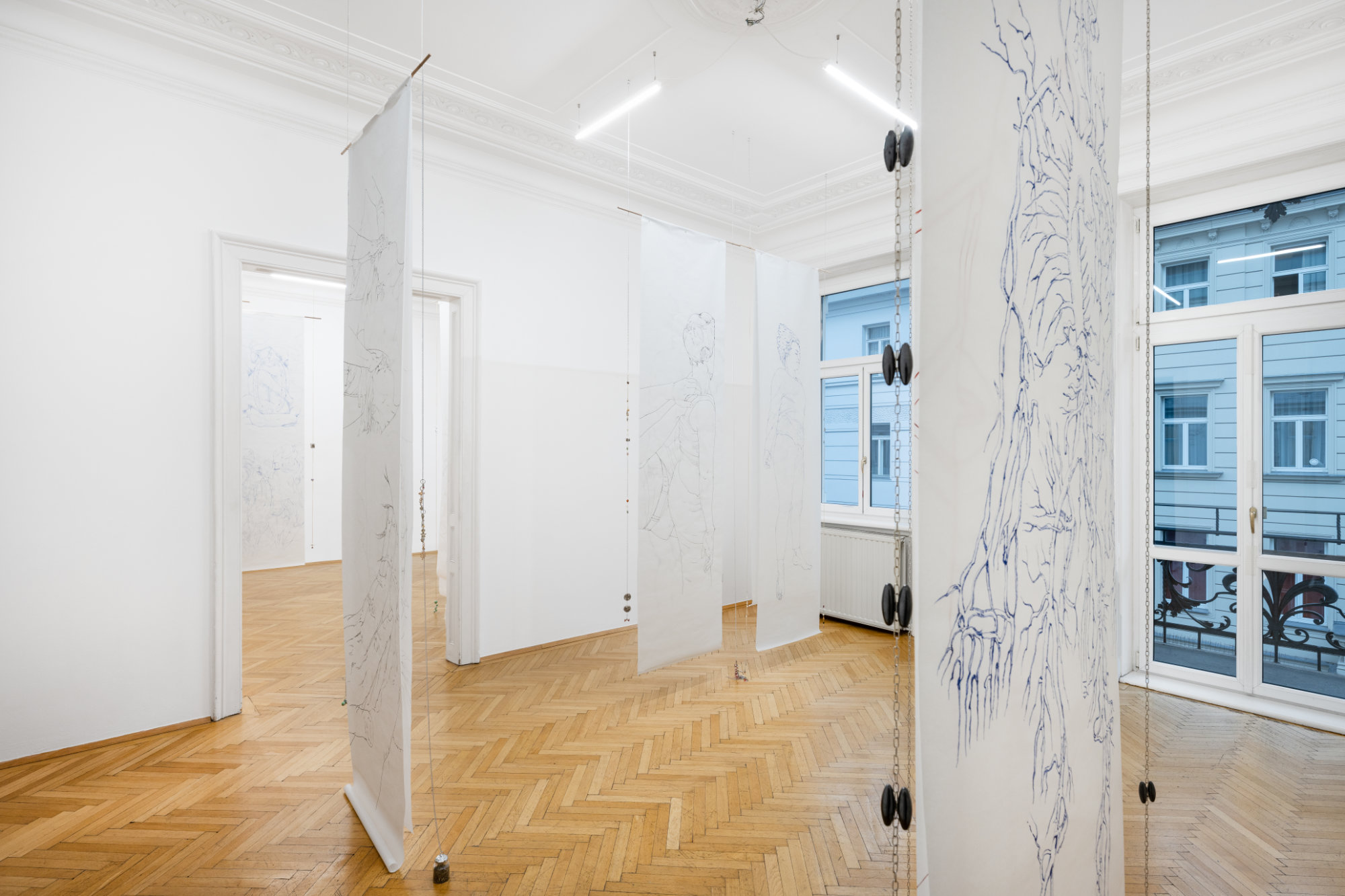
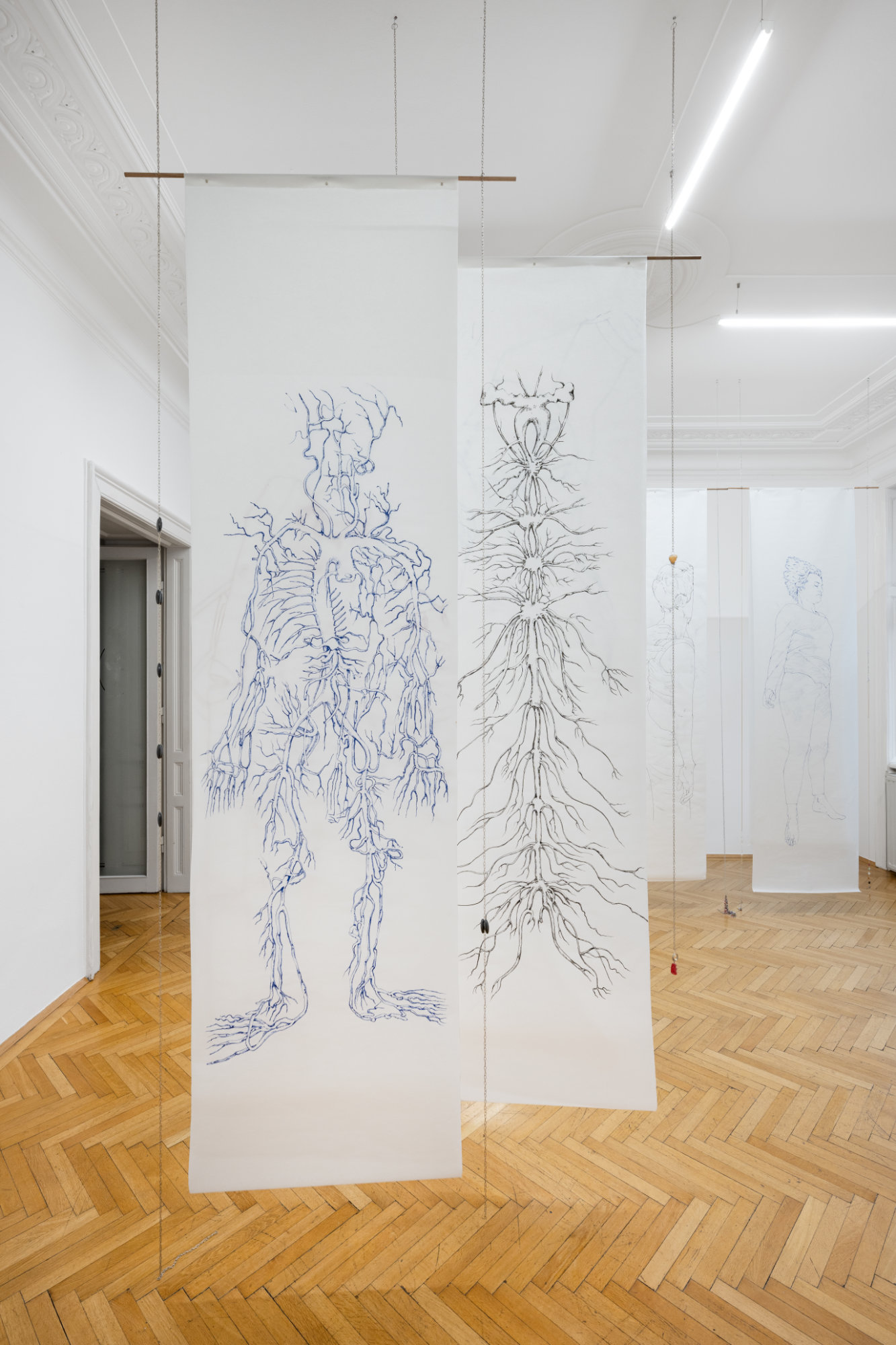
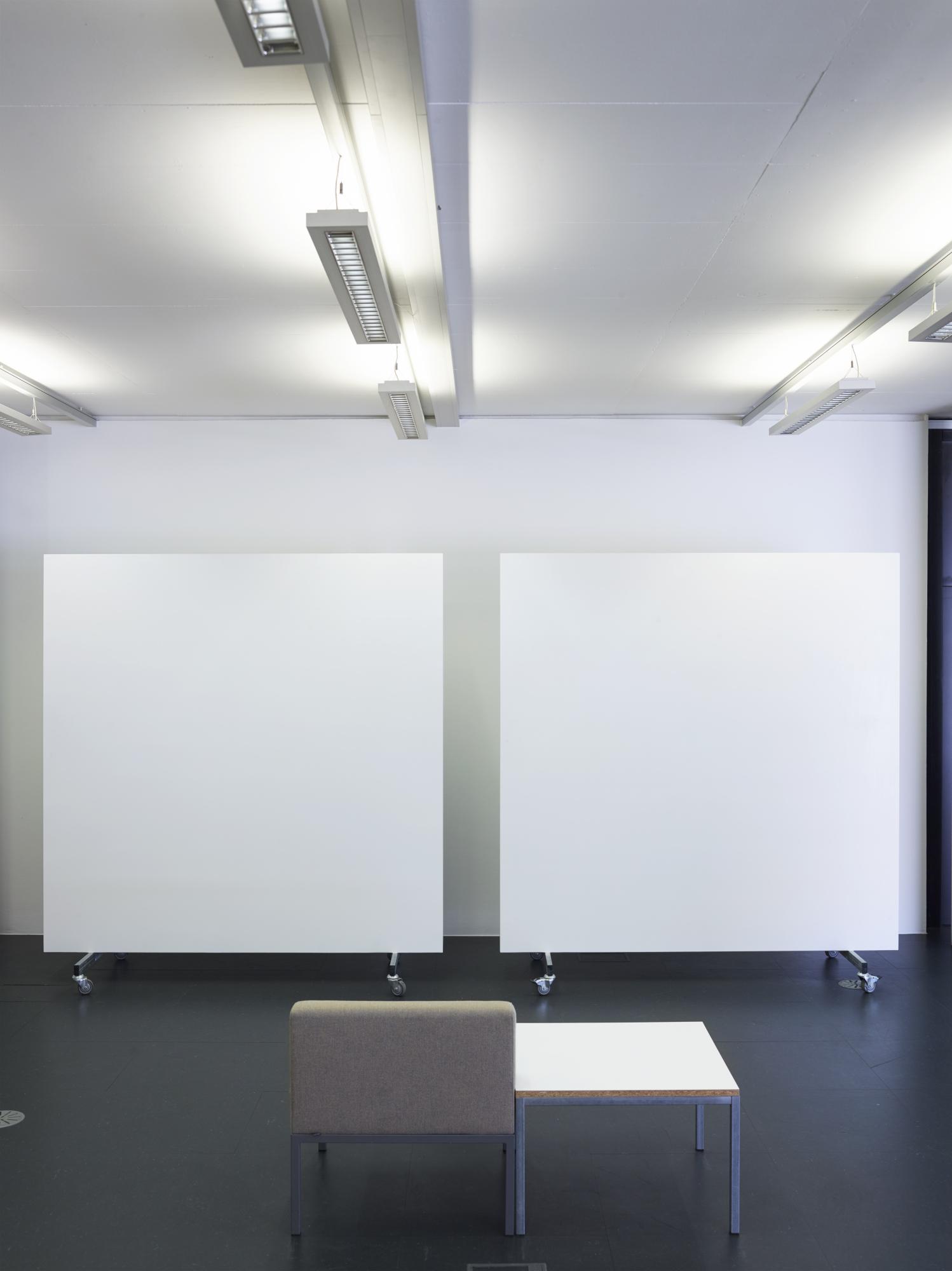
Touch runs like a thread through Minda Andrén’s artistic practice and carries over in her installation works in the exhibition space. For example, in the presentation of her drawings. Unlike conventional paintings hanging flat against the wall, they are suspended freely from the ceiling into the space. These delicate line drawings float like bodies between the floor and the ceiling, interacting with the bodies that surround them, of the visitors and the other works, too. Figures, drawn in ink or charcoal on rolls of paper several meters long, larger than life, claim the space not just as their image plane but as a space for movement. The viewer approaches them, must walk around them, pass between them, step back, and approach them again. One’s own body becomes a protagonist in a spatial choreography.
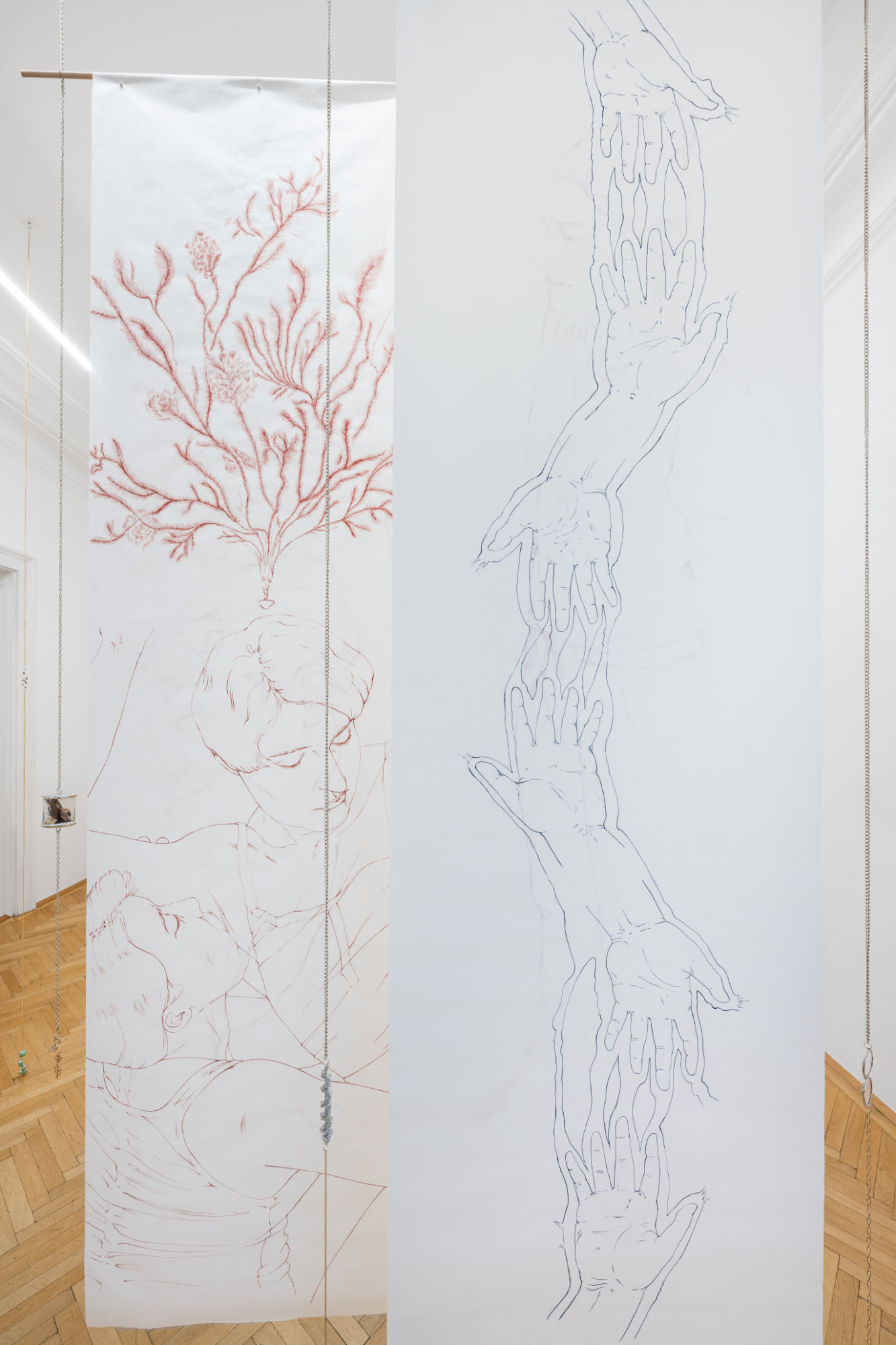
Some paper rolls are coupled in pairs. Andrén hangs the works back-to-back, the drawn front sides facing in opposite directions. Both sides share the same pictorial body, yet they can never be viewed in one glance. Rather, with each and every motion, the viewer triggers a shift in perspective, exposing new body fragments, lines, and layering. The image emerges not only on the paper, but in the contingent relationship between work, space, and audience.
This relationality is enhanced by another physical property of the paper—its transparency: one drawing always shimmers through into the other. In 12 spinal nerves (2026), for example, a woman is seen lying on the floor in a relaxed pose. Presumably in “Shavasana,” the so-called Corpse Pose that typically concludes a yoga session. Or perhaps she is practicing autogenic training, or maybe it’s just an afternoon nap. On the second drawing, attached from the rear to the woman in the first, hands can be seen, one on top of the other, in a movement depicted in the style of a massage guide, an “instruction manual,” if you want. When backlighting falls on the installation or it is set in motion by a draft in the room, the two sheets of paper touch, and the drawn hands seem to gently massage the resting woman.
Here, Minda Andrén adds another dimension to the idea of touch. No longer is it merely the subject of the depicted bodies and the material principle behind the making of the image; it is also an experience of reception. The drawings touch the space; they touch one another and invite viewers to constantly renegotiate their own physical position. The exhibition itself participates in this matrix of touching, where bodies encounter another not as immutable entities but as relational configurations.
Fig. 3
The man’s left arm is raised and guided at a right angle against his lower back. Supported. One hand directs his shoulder flat downward, applying weight with cautious, even pressure. A second hand grips around his elbow, fingers gently closed around the joint, as if carefully guiding the upper arm through the movement. The muscles of both bodies are tense, connected in a shared flow of movement. The range of motion is deliberately held in balance. The face of the man lying on his stomach is turned to the side, it sinks into the bedding gently carrying his bare torso. No resistance, no gaze. Touch born of trust.
What arises in each individual work and group of works is intrinsic to Minda Andrén’s artistic practice as a whole: expanding beyond the visual motif, care, healing, intimacy, and control permeate the images’ materialization and the spatial experience of the exhibition itself. The images emerge between paper and canvas, between water, ink, and oil paint, and between the work, architecture, and viewer. They are embedded in the process of convergence, transfer, and separation that translates the depicted bodies and their mutual relationships within the medium of painting itself. Although the artist departs from existing visual sources, her artistic interventions shift their original meanings. The images of relaxation, therapy, spirituality, medicine, or pop culture do not represent social discourses. Touch is rendered neither as an explicit expression of care nor of violence, liberation nor control. It remains suspended in a moment of physical negotiation in which proximity and distance, self-determination and dependence, vulnerability and desire are continually reevaluated. Thought configurations lead to body configurations, which in turn bring about body reconfigurations.
By staging the body in its relationality, Andrén points beyond the individual to the social, cultural, and political realities that inform and shape it. Philosopher Jule Govrin describes just how deeply such power relations are already inscribed in the spatial arrangement of bodies: “Above and below, left and right do not merely denote physical points of orientation but also social relations and political conditions: Above and below signify power and powerlessness, domination and subjugation. The body itself becomes the template for the power relation.” Andrén’s artistic works play off of these relations. Politics become tangible as a negotiation of how bodies relate to one another, how they touch, encounter, or are separated from one another. The body is a witness to constant aesthetic, social, and political realignments—in every painting, every drawing, and every installation anew.
Franz Thalmair
Photos
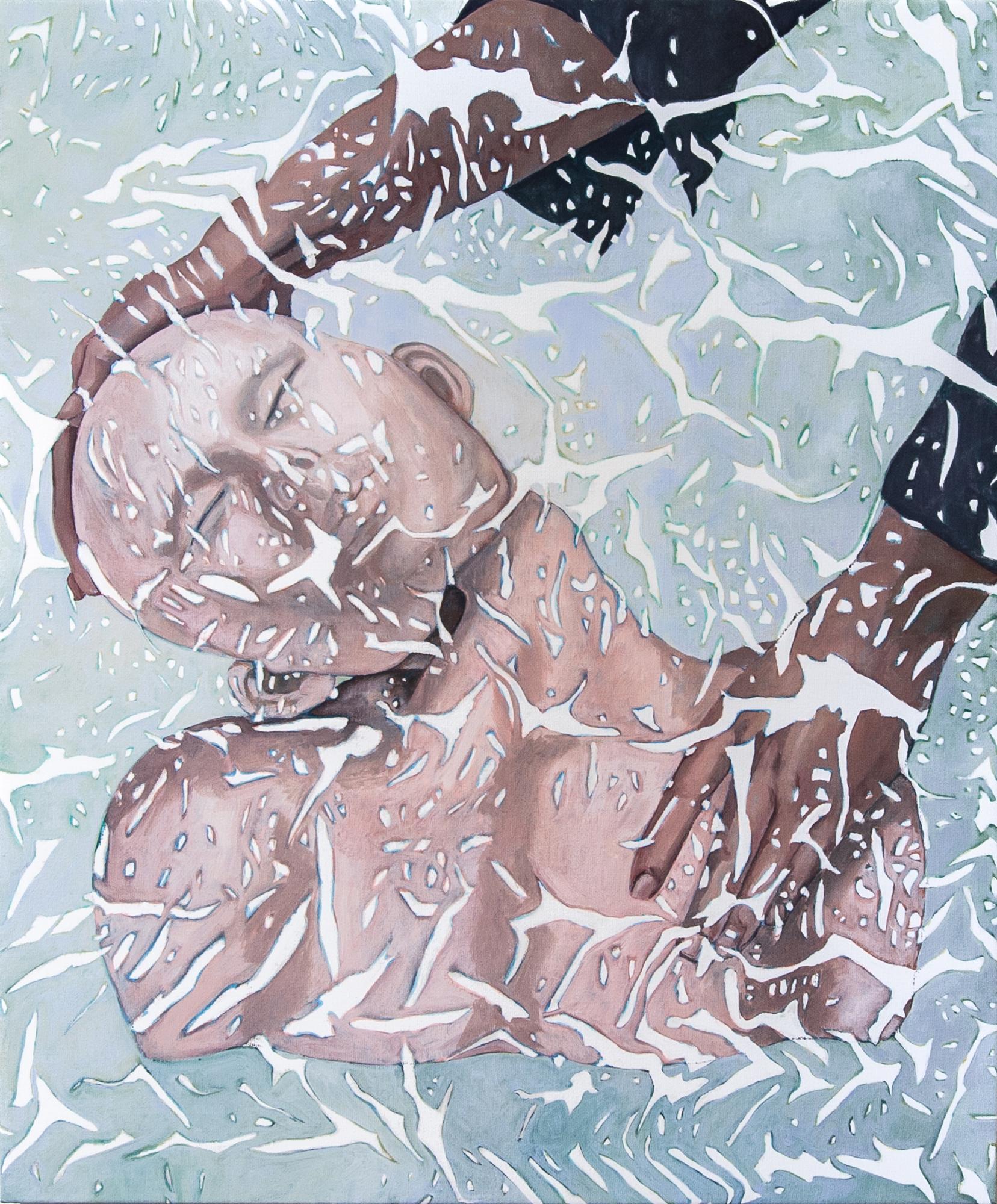
Minda Andrén: The Practice (2026), 60 x 50 cm, Gouache on cotton canvas
Leka Mendez, 2026
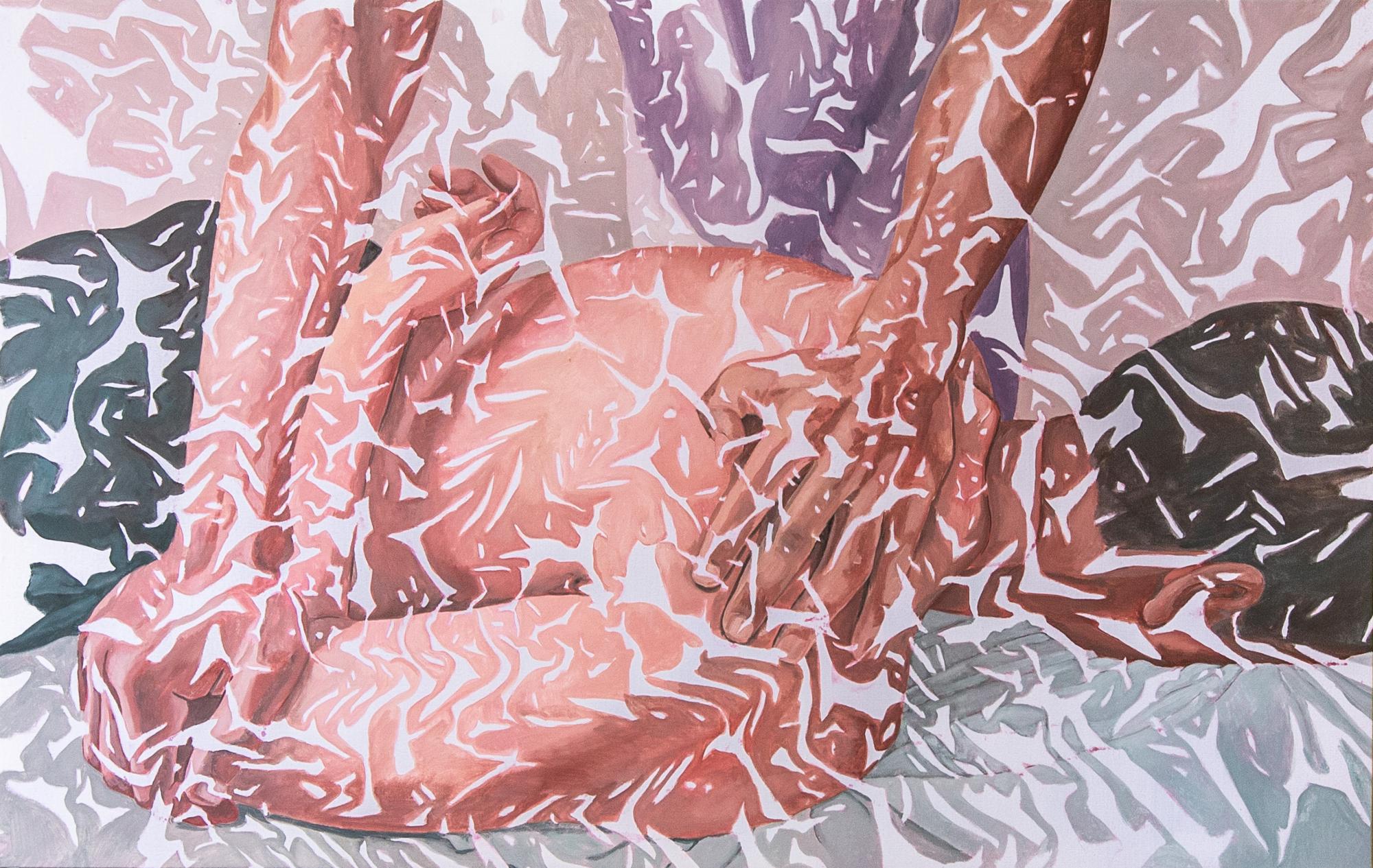
Minda Andrén: Wellness (2026), 70 x 110 cm, Gouache on linnen
Leka Mendez, 2026